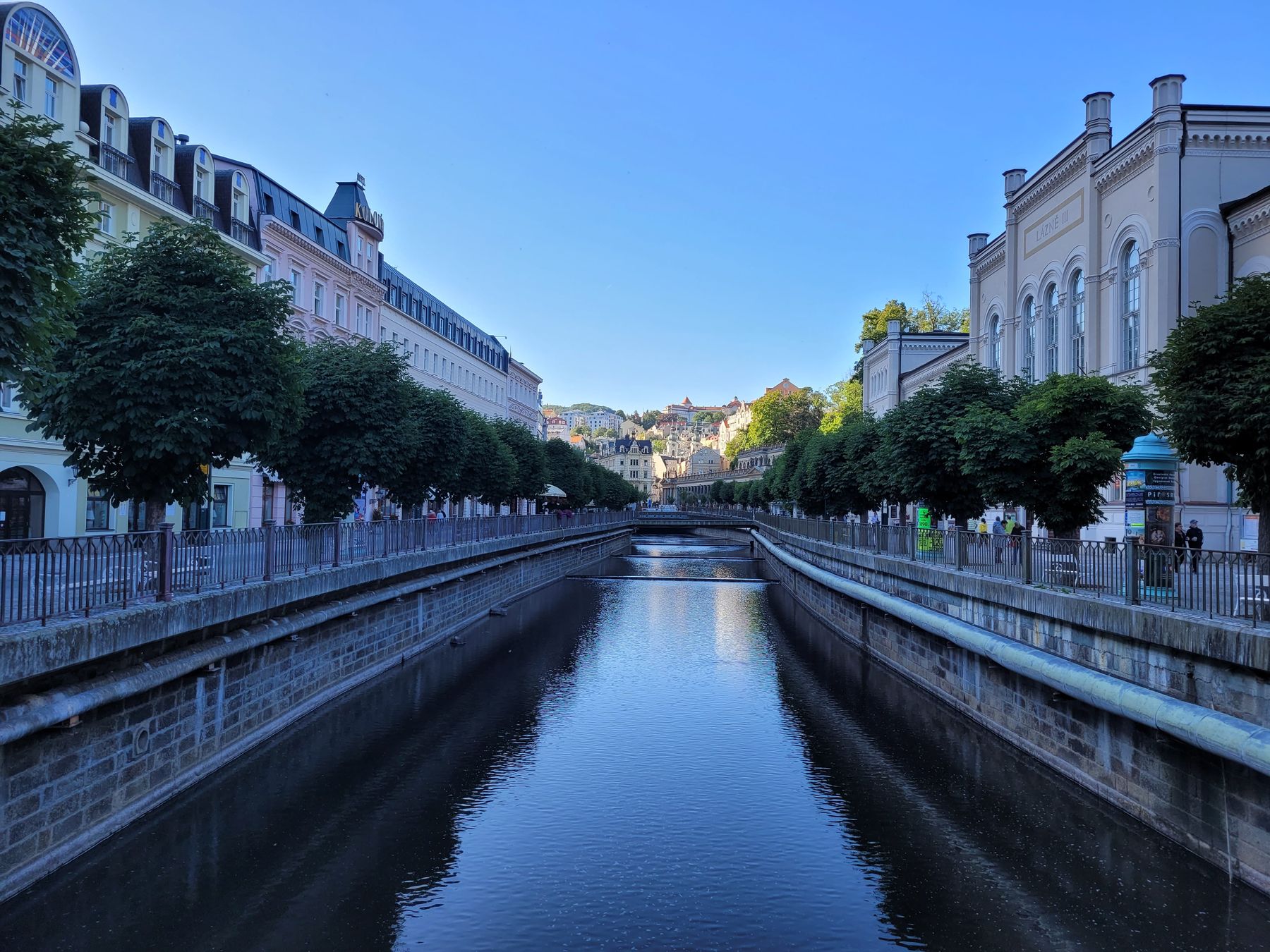
The Teplá stream near the Spa III building at sunrise
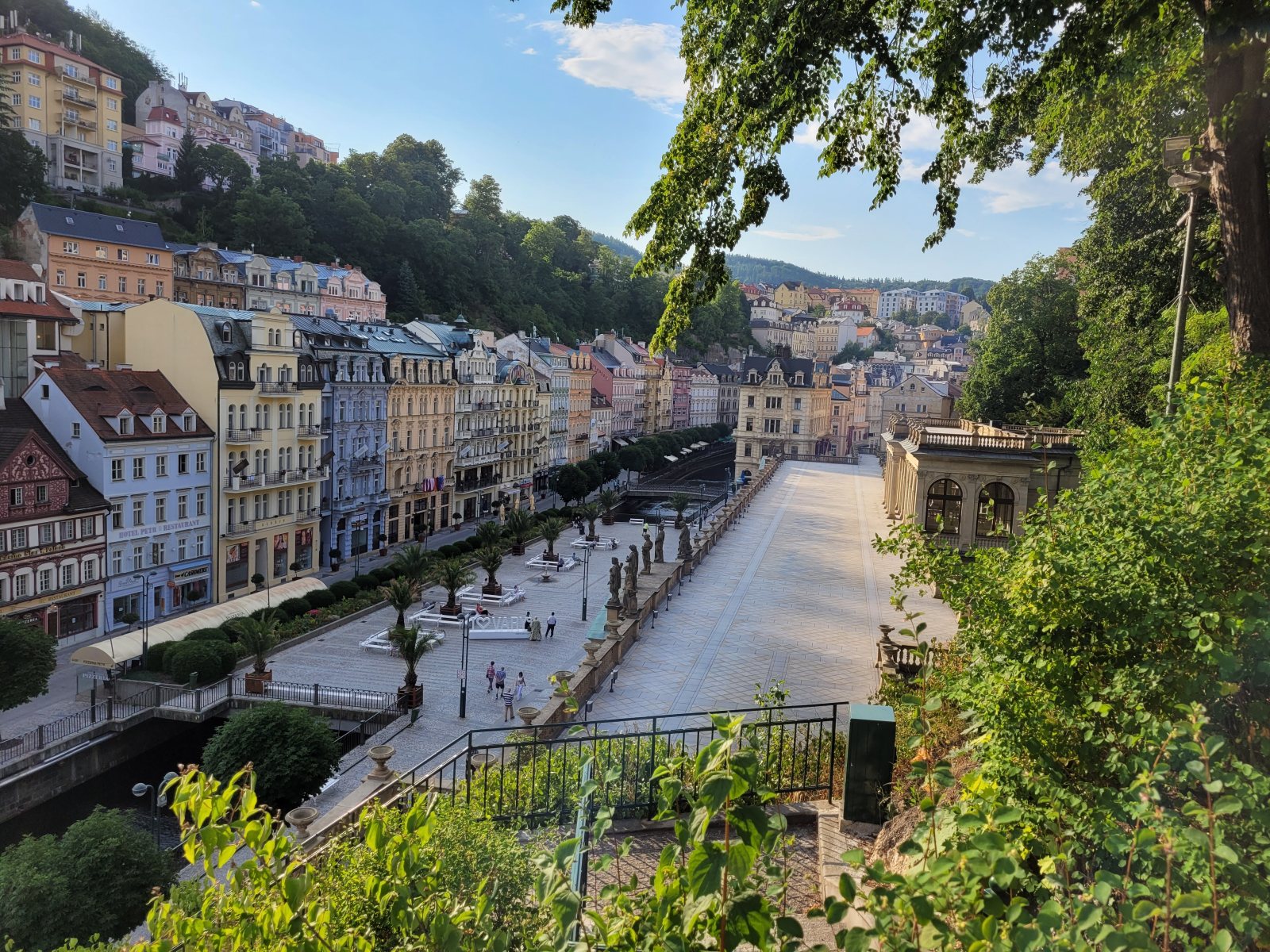
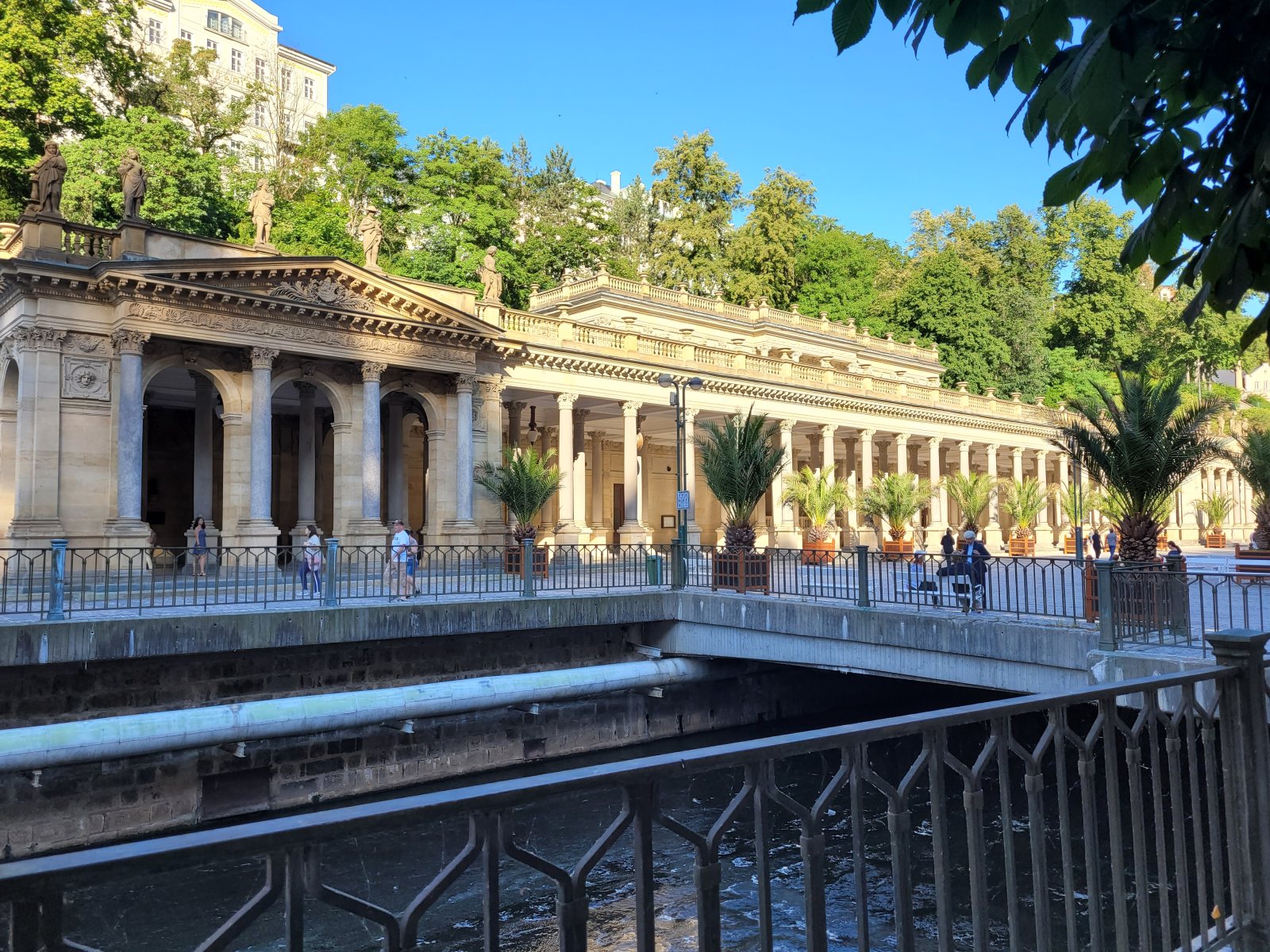
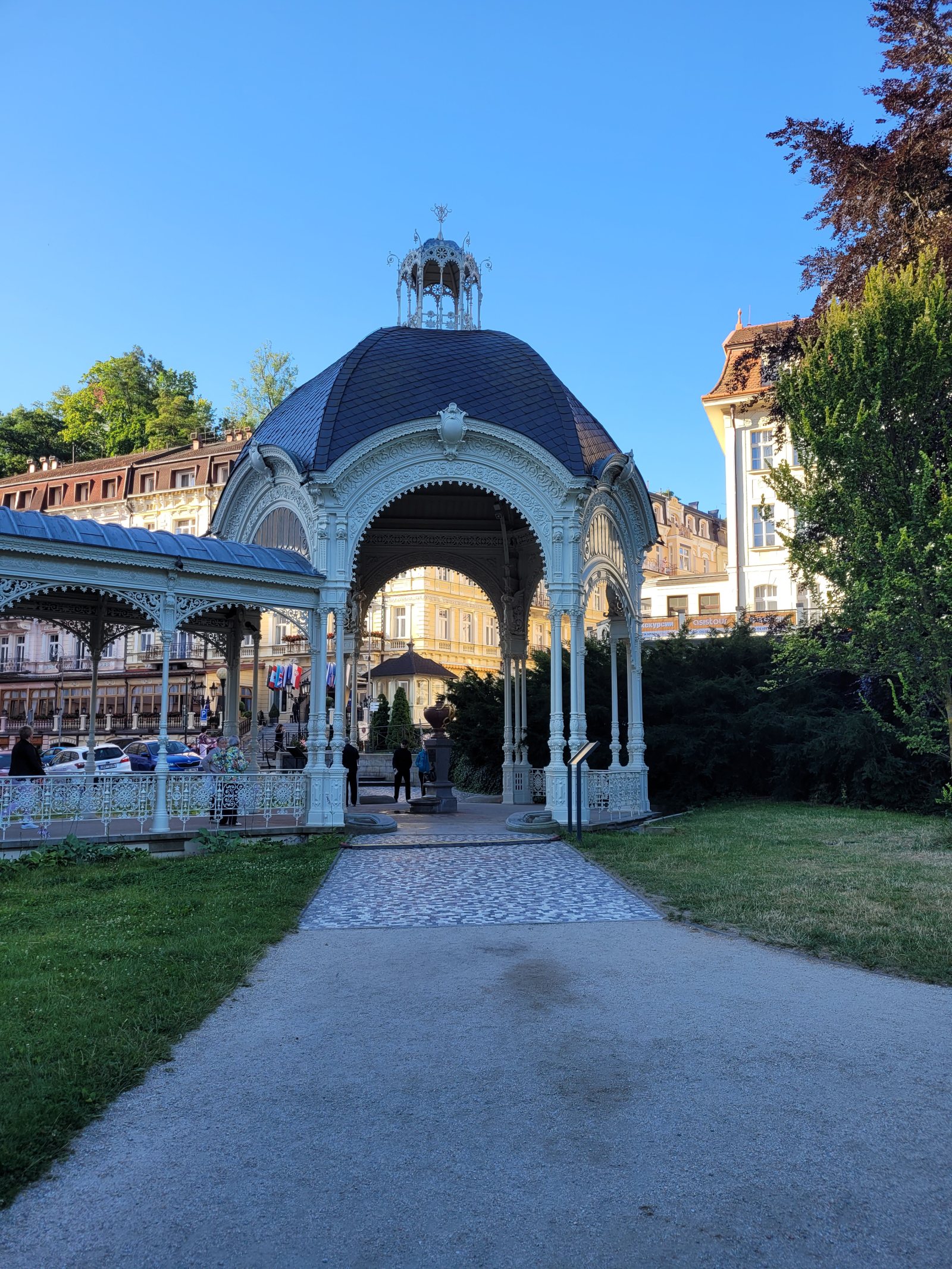
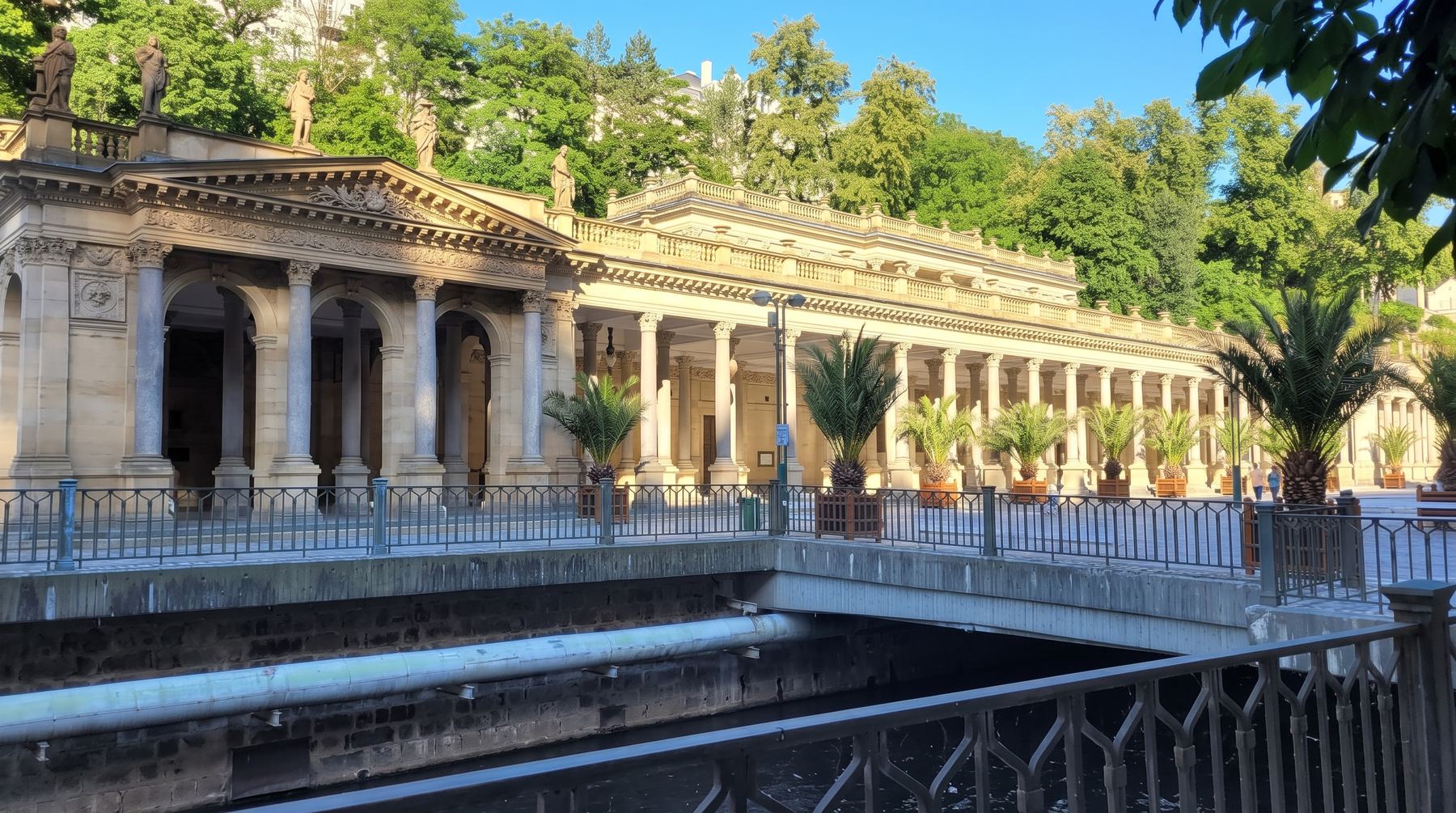
The Mill Colonnade with its columns and statues on the roof, with the channel of the Teplá stream in front
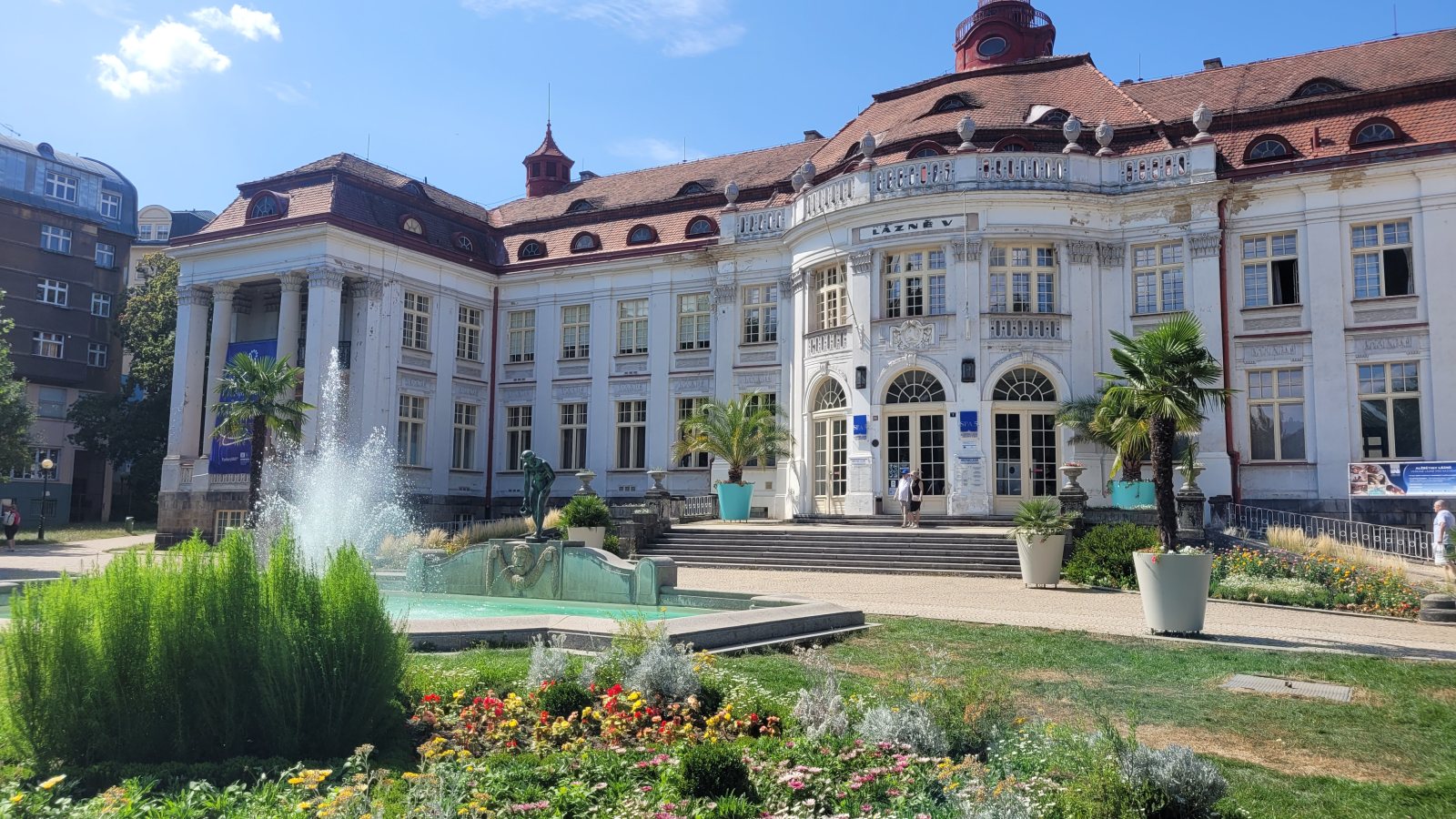
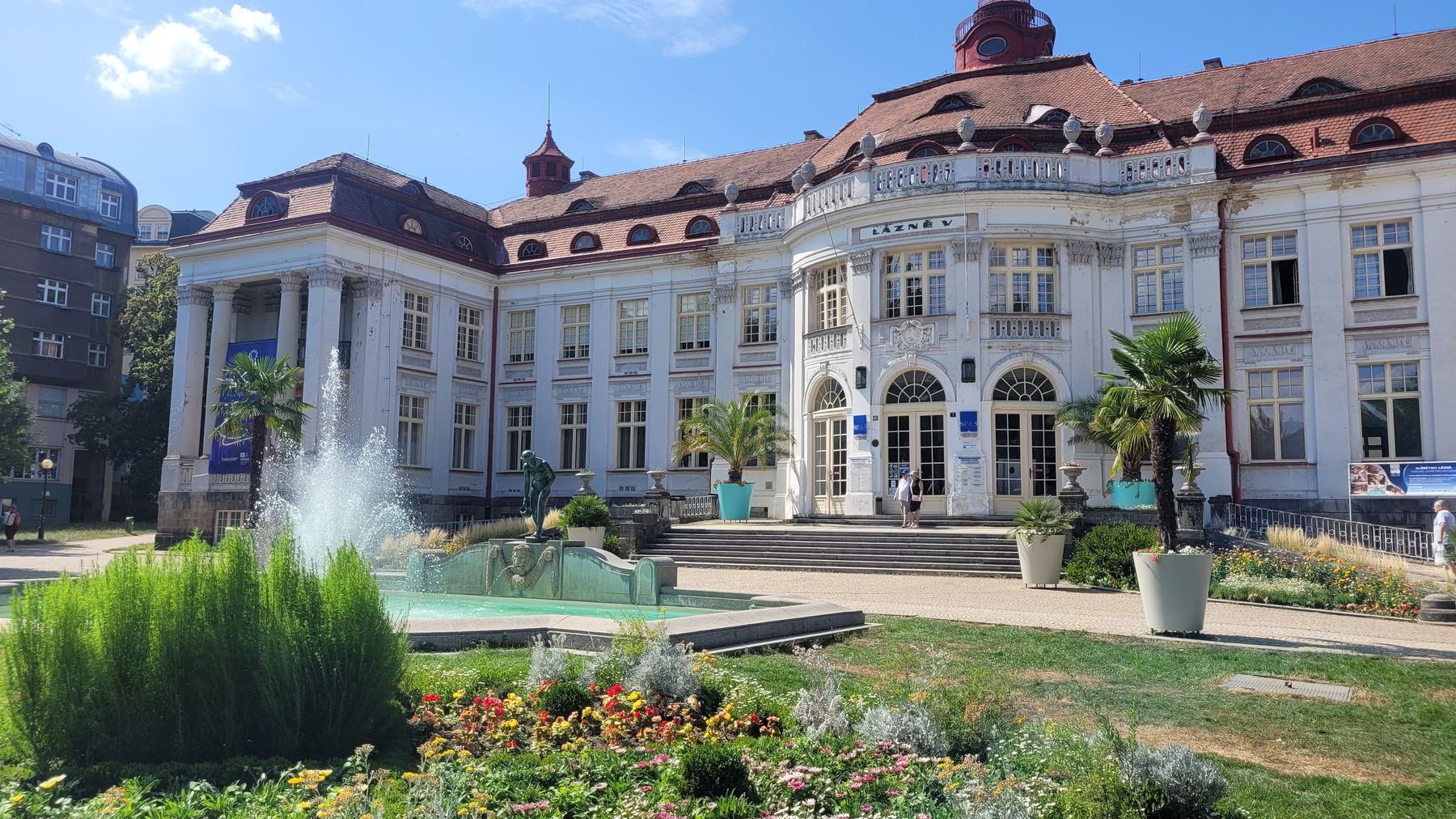
The spa building known as the Elizabeth Baths, with a fountain, palm trees and a flower bed
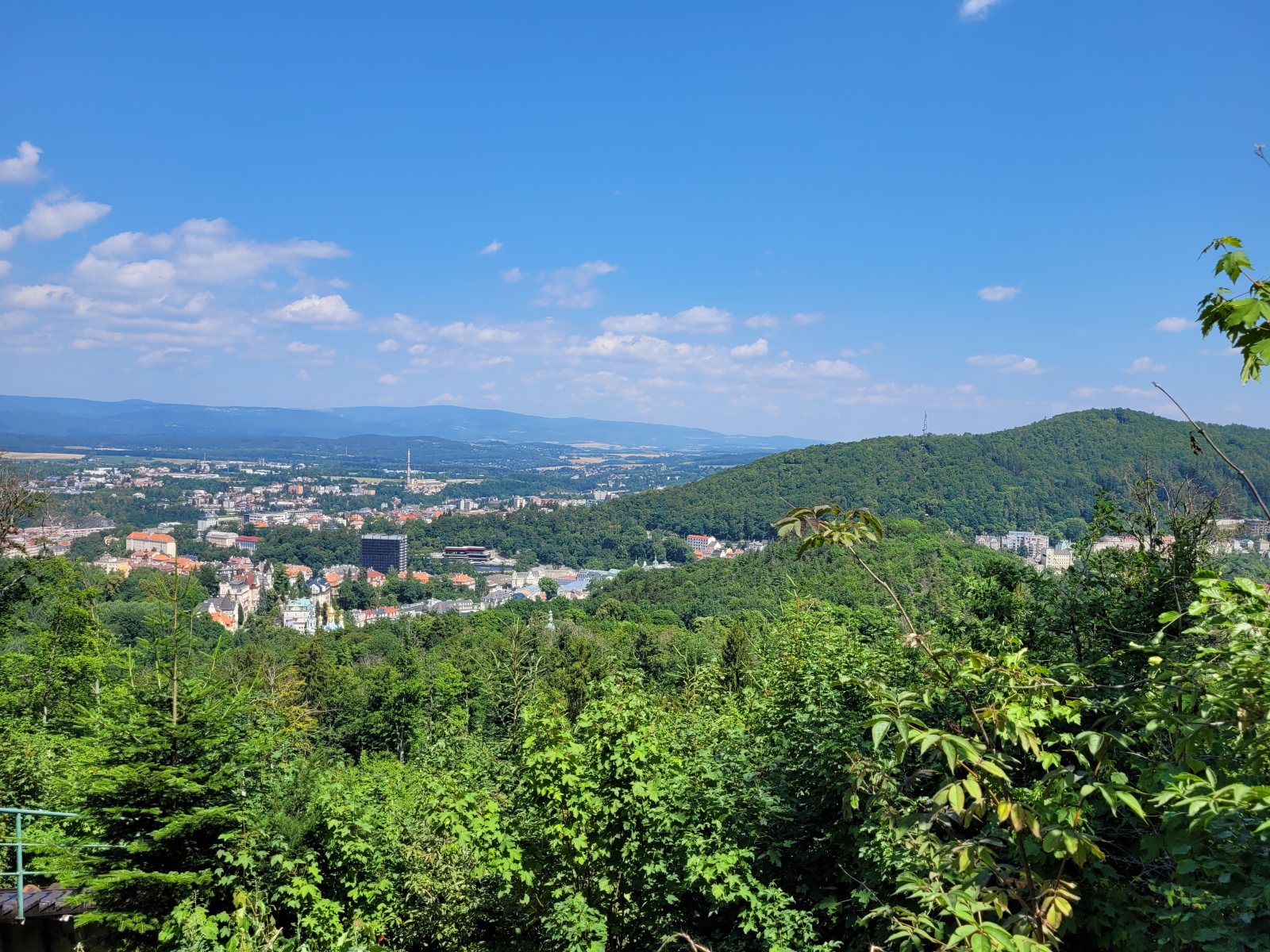
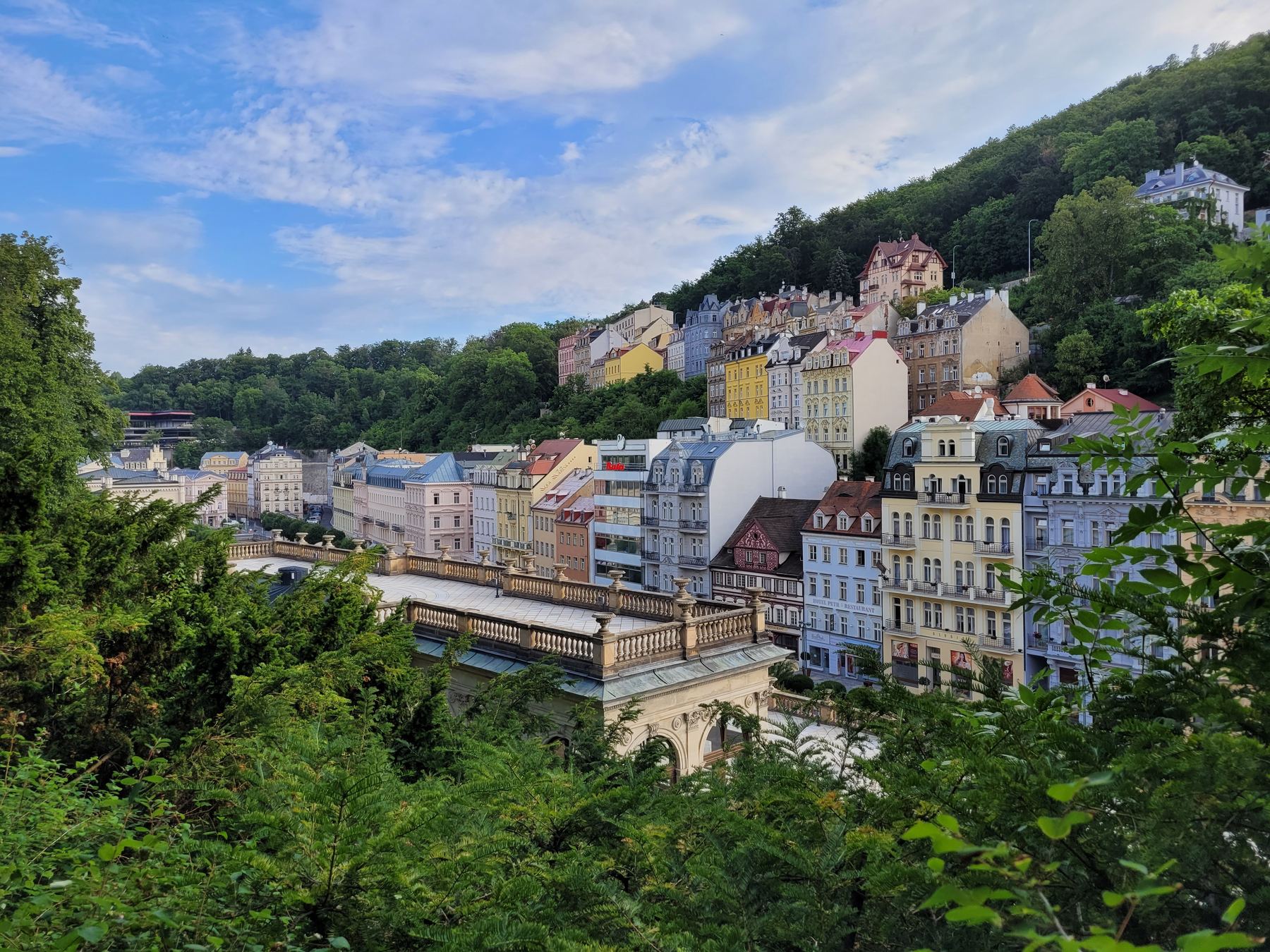
A view from above of colourful houses in the spa centre, with greenery in the foreground
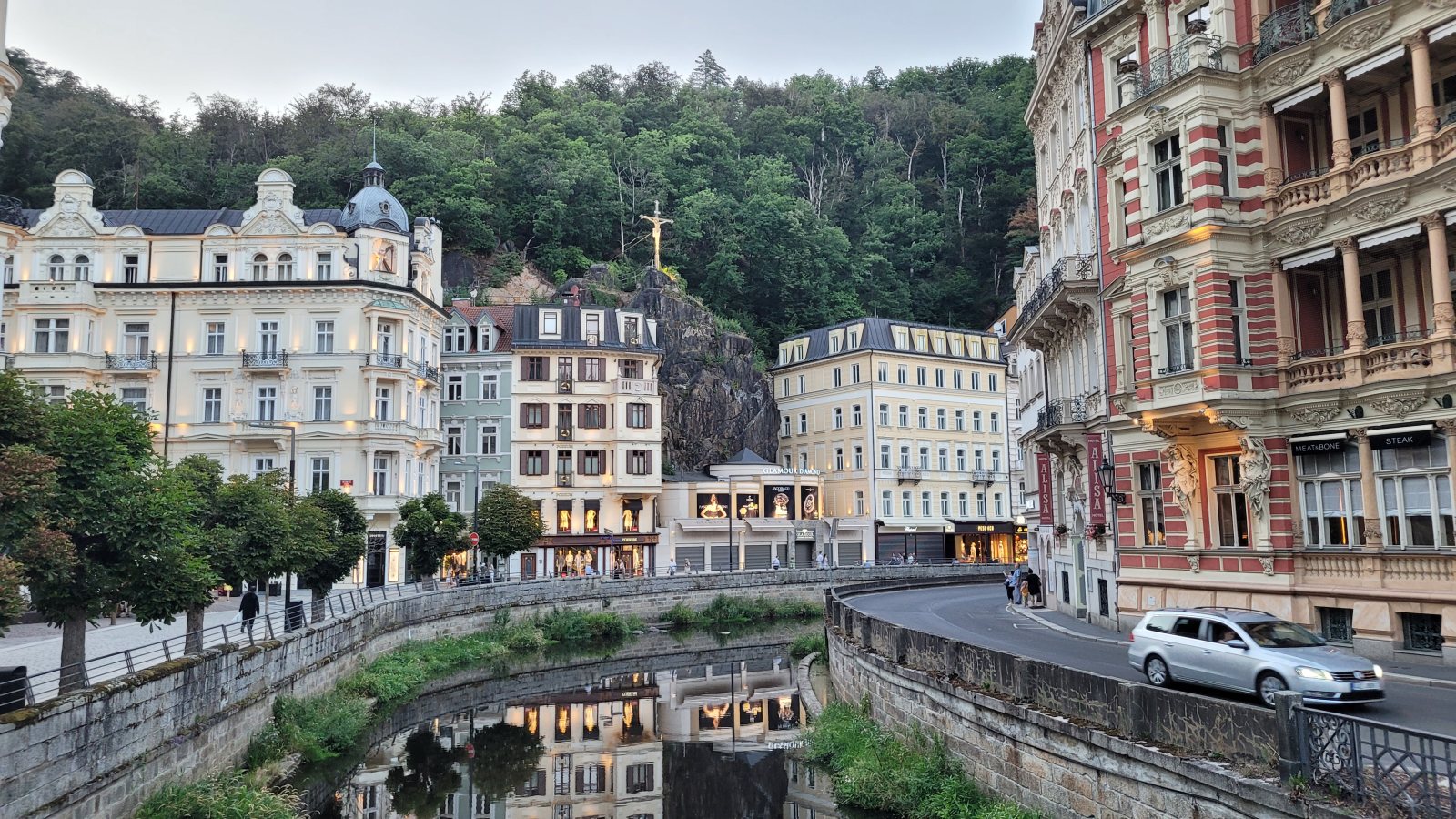
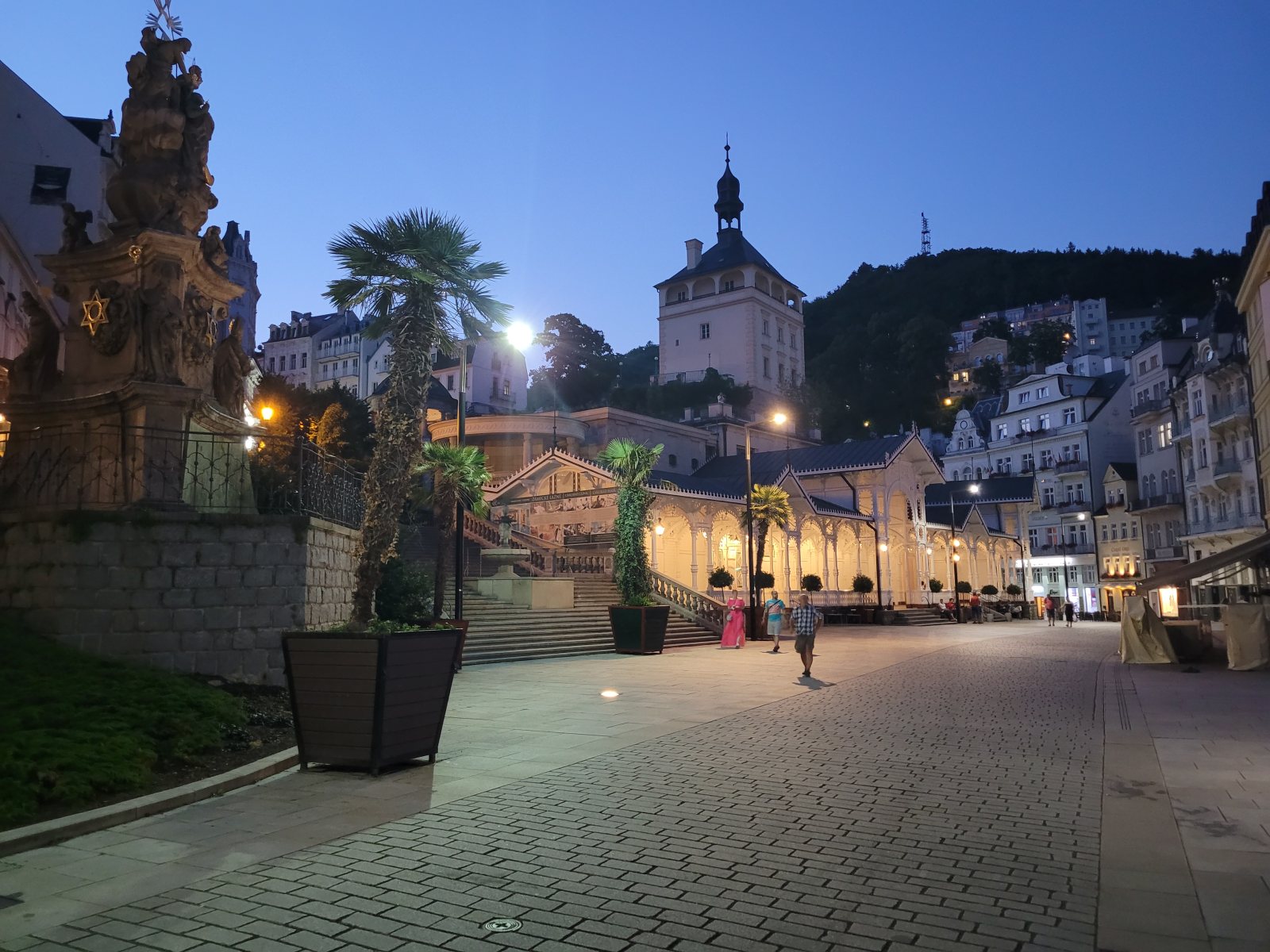
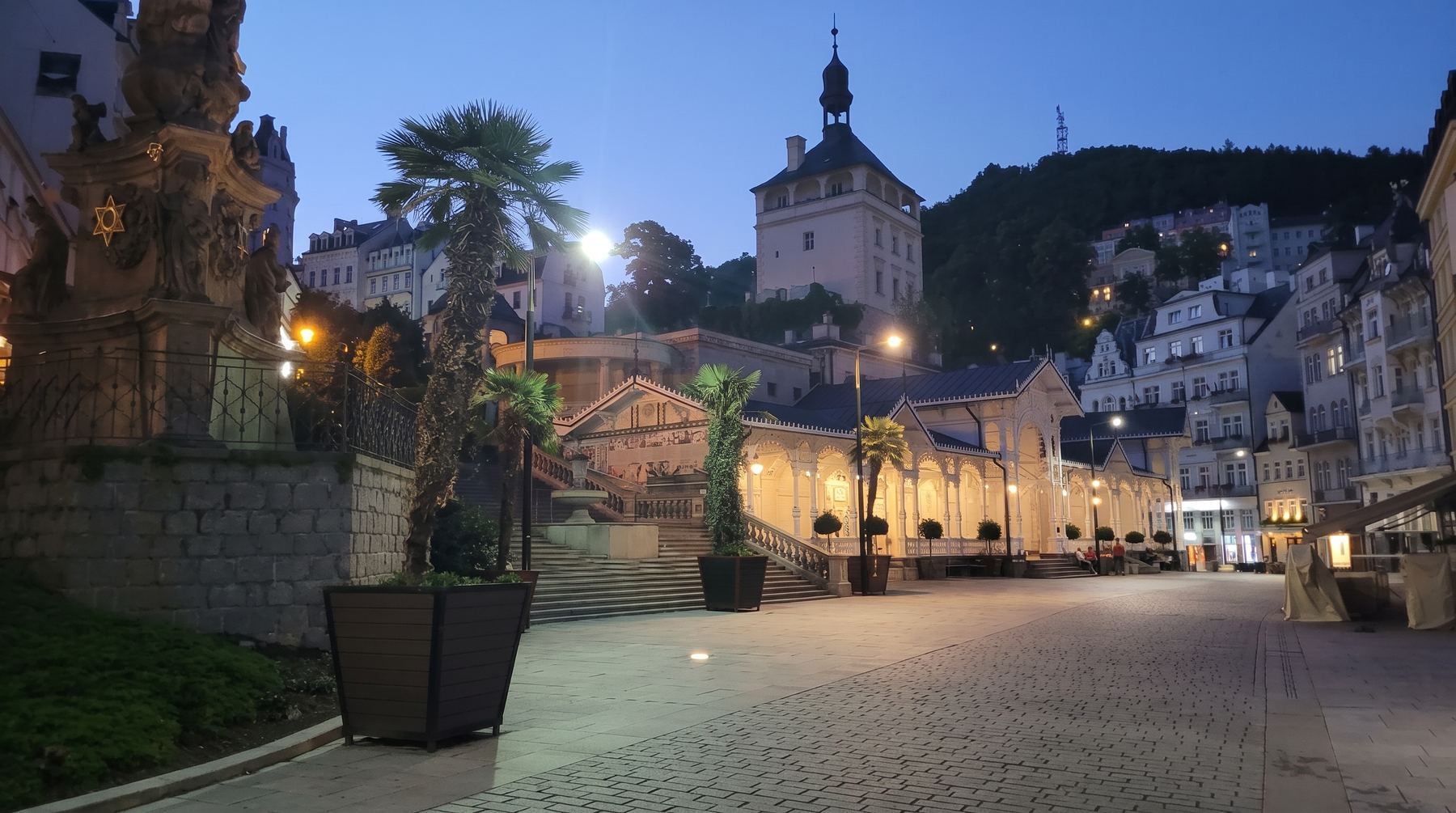
The Market Colonnade in the evening, with the Castle Tower above the illuminated square
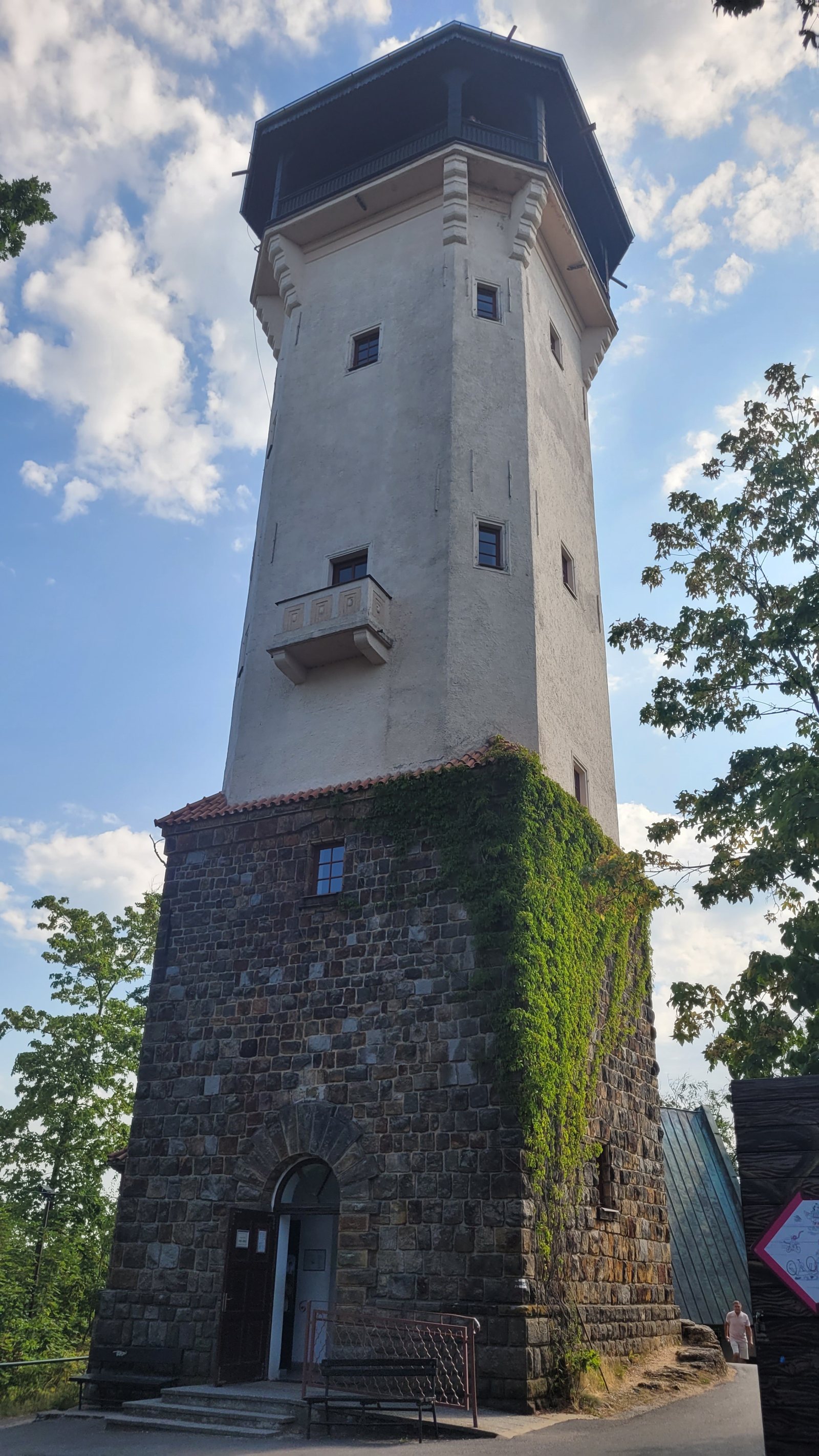
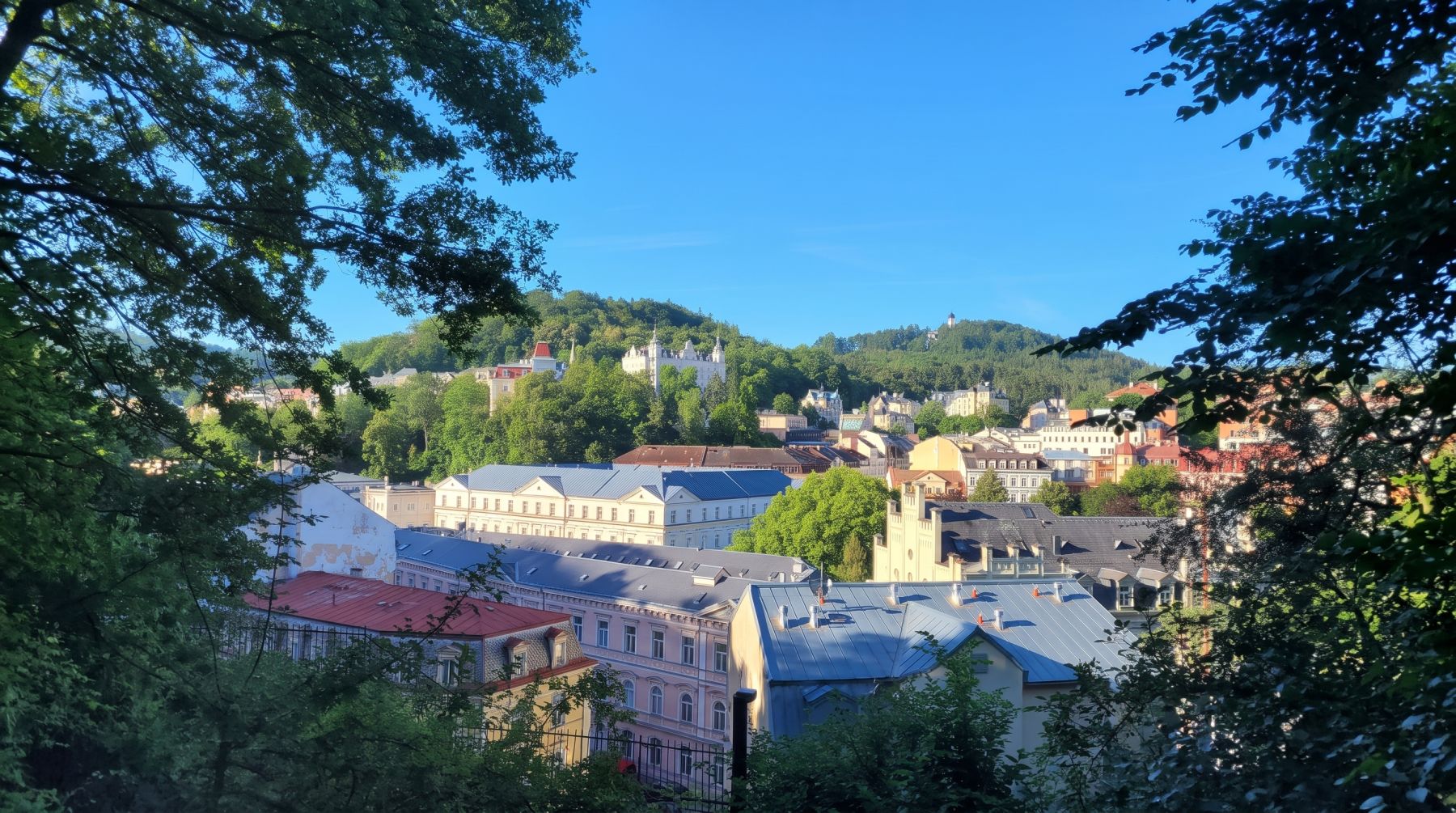
View of the Diana Lookout Tower from the Hotel Thermal
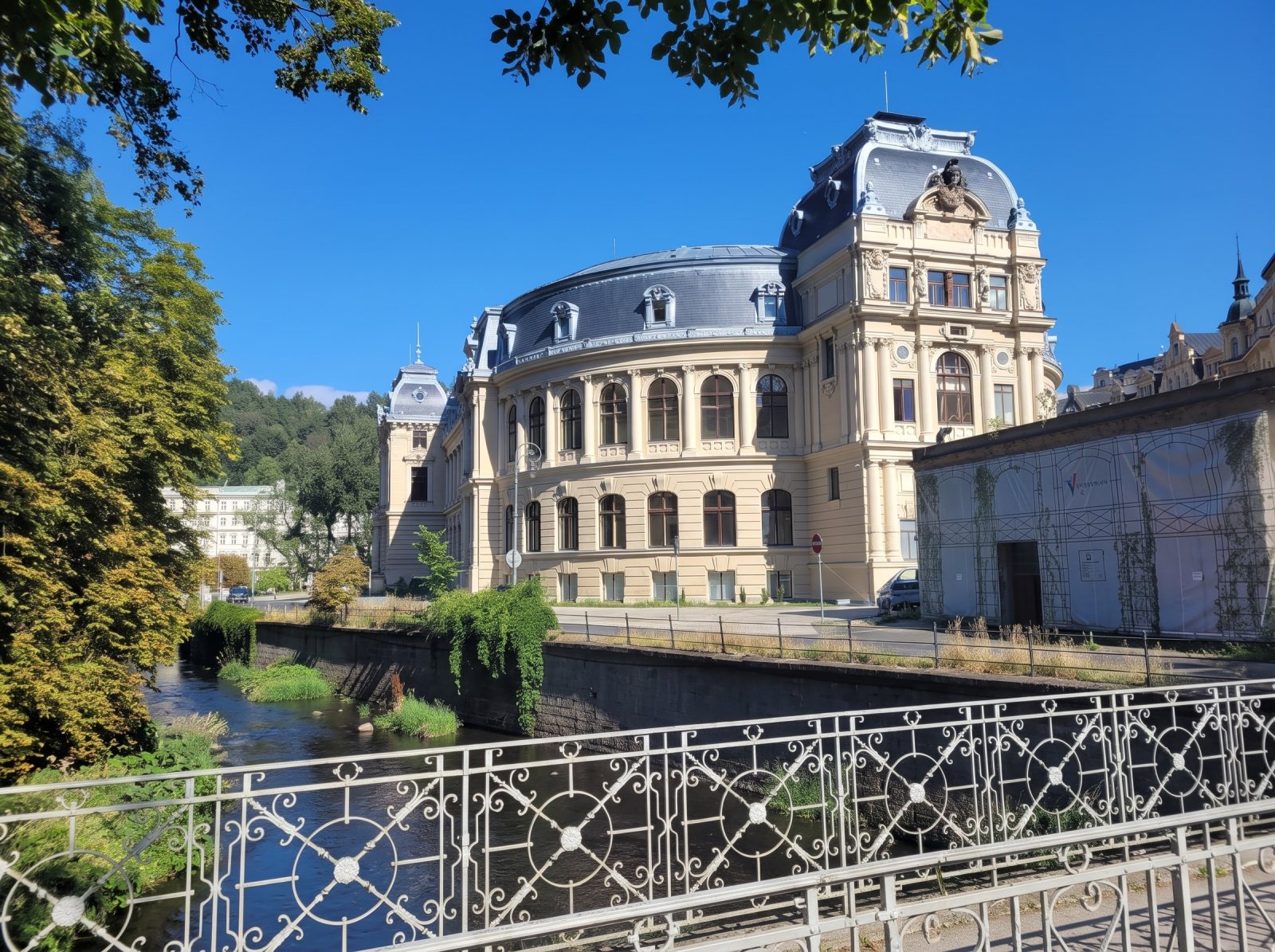
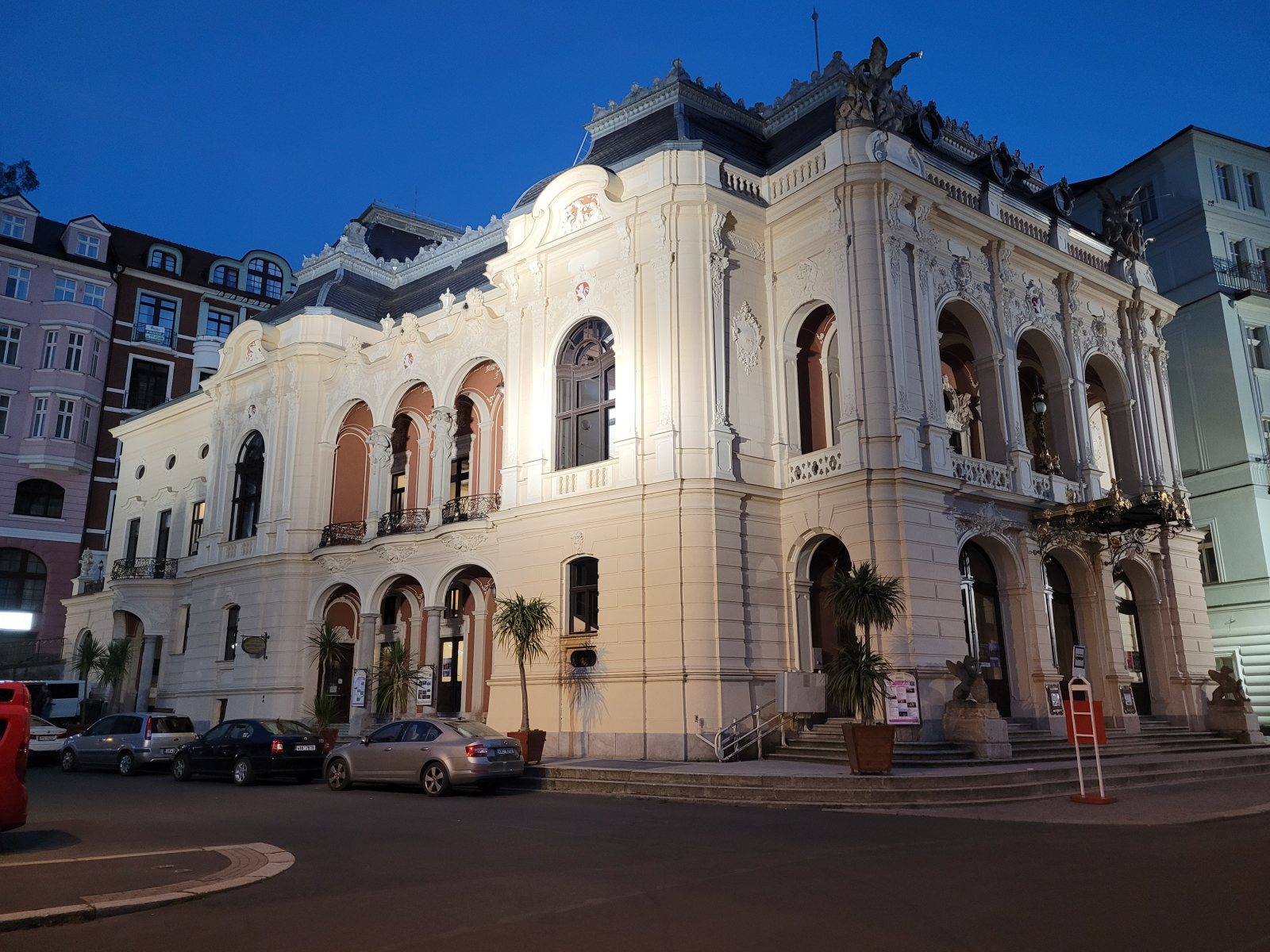
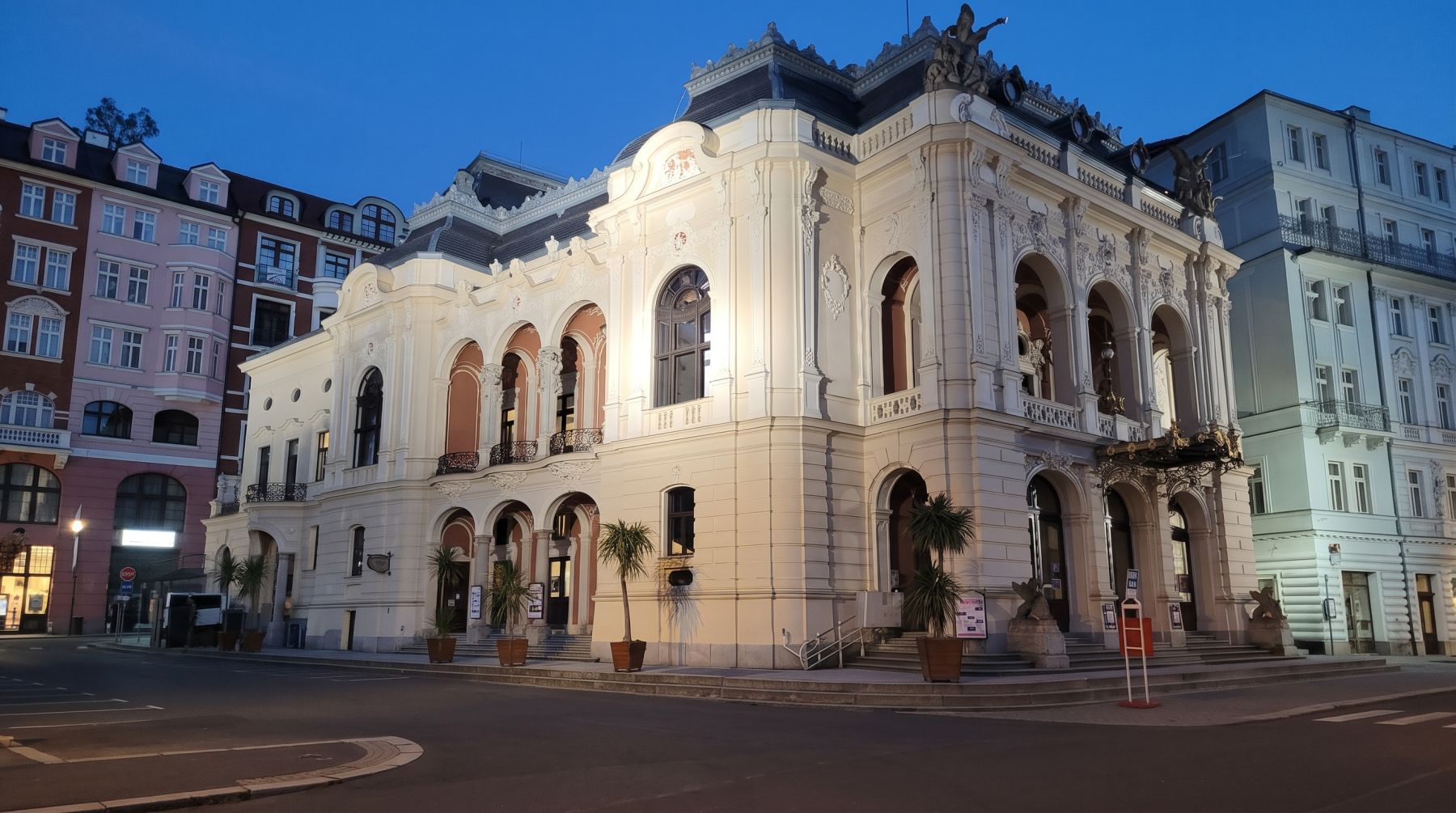
The Municipal Theatre in Carlsbad

Plaváček’s
Guide to Carlsbad

A short sightseeing walk through the spa town

Stroll through the spa town at an easy pace, in two parts with a break for a good lunch. Open the route in Mapy.cz, the Czech map service, or download the guide as a PDF and take it along. It may come in handy, so that you know what you are looking at.

Part One of the Route

From the statue of Tomáš Garrigue Masaryk to the Diana Lookout Tower

Stop 1

The Founding of the Town
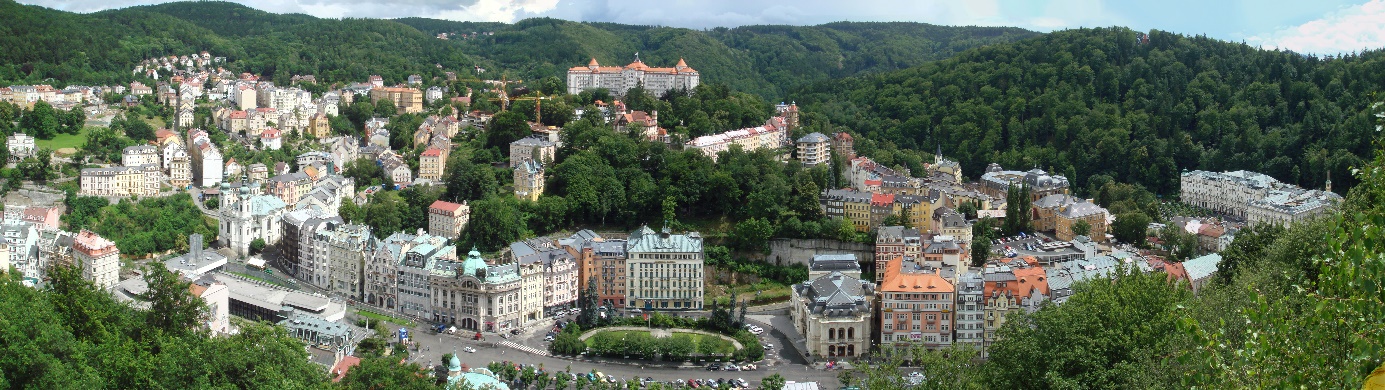
Panorama of Carlsbad in the valley of the Teplá riverSource: City of Carlsbad
View of Carlsbad from the Diana Lookout Tower
Carlsbad
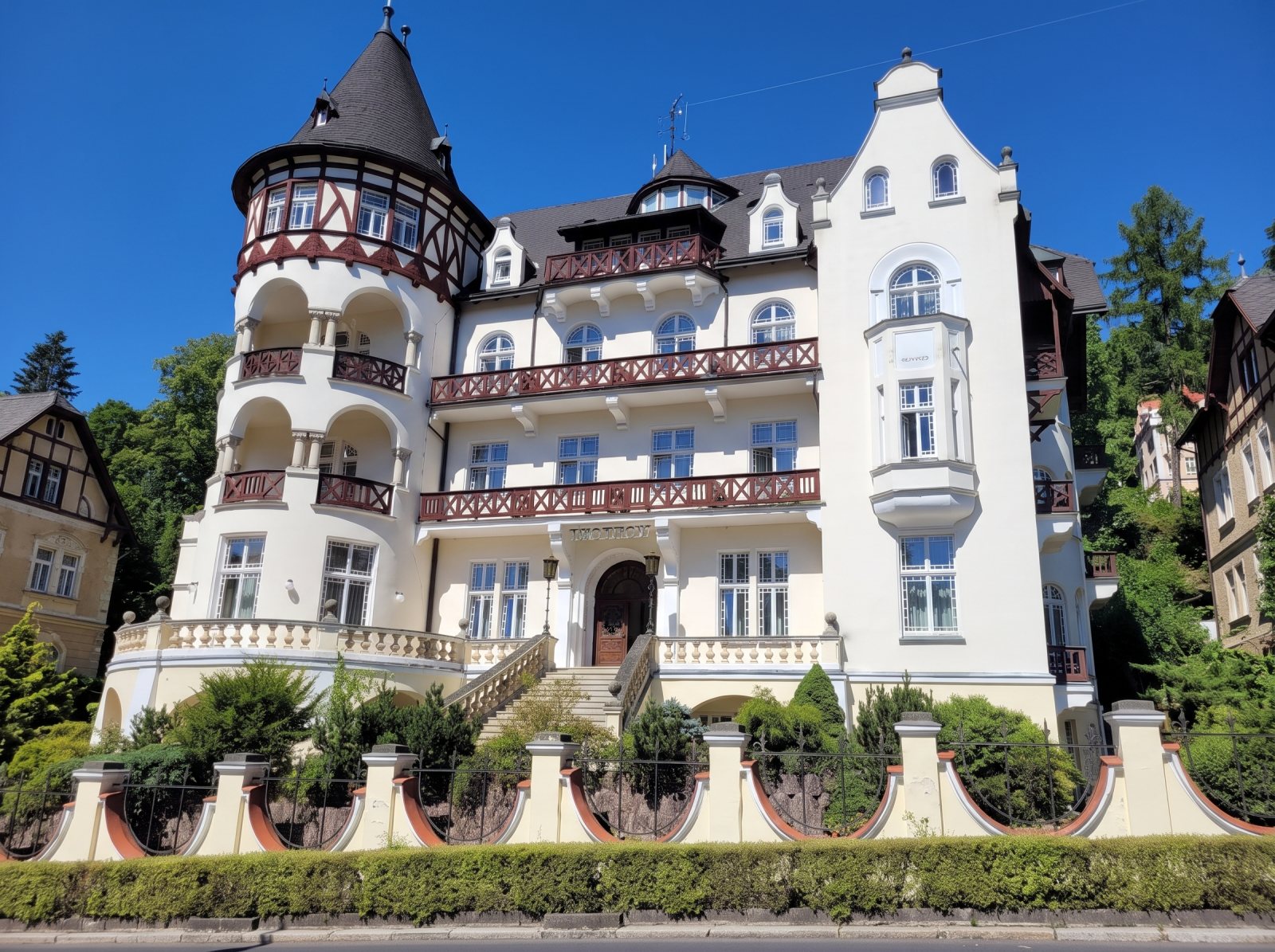
A snapshot of the Westend district of Carlsbad
The Imperial Spa
View of the Mill Colonnade
Almost everyone knows the legend of how the spa town was founded. The story goes that Charles IV set out hunting in the valley of the Teplá river and chased a stag for so long that the unfortunate animal, quite fed up with the whole business, leapt off a cliff into the deep valley below. As luck would have it, the antlered fellow landed precisely in a hot, healing spring, shook himself off, climbed out – and was cured. Nobody ever saw him again. The wise emperor understood at once what miracle he had discovered and founded a town on the spot. Among other things, he is also said to have healed his injured leg here. So much for the legend.

The fact is that, in the light of present knowledge, the most likely years for the founding of Carlsbad (Karlovy Vary) are 1347 or 1349. The year 1358 is also given, but that can only refer to the building of a fortified lord’s residence – really a small castle, of which only the Castle Tower survives today – in a village that already existed. In 1370 Charles IV granted the town the privileges of a free royal town.

So let us accept that the annals of history will probably never reveal the true date on which the spa town of the hot springs was founded, and let us be glad that we have this town at all, even though it never had it easy.

In 1582 an enormous flood destroyed almost all of it, and in 1604 it burned to the ground – only three houses were left untouched. In 1640 the Swedes arrived – and looted and plundered to their hearts’ content. In 1759 a great fire struck the town again and 224 houses vanished into thin air. And finally, in November 1890, the spa was hit by the largest flood in the history of Carlsbad, which did enormous damage. Some 400 little shops were destroyed and more than 200 houses were seriously damaged. The mayor of the day lost his life as well.

Each time, though, the people of Carlsbad built their town anew, as you can see for yourself. A short walk through the oldest villa district in town, which used to be called “Westend” and which grew up gradually towards the end of the nineteenth century, will be a journey not only through space but also through time.

We set off from the statue of our first president, Tomáš Garrigue Masaryk, and after a few minutes we pass, on the left, Anna Politkovskaya Park. Politkovskaya was a Russian journalist, writer and political activist with Ukrainian roots who had unsettled scores with Vladimir Putin, so she was shot dead in Moscow on 7 October 2006.

Stop 2

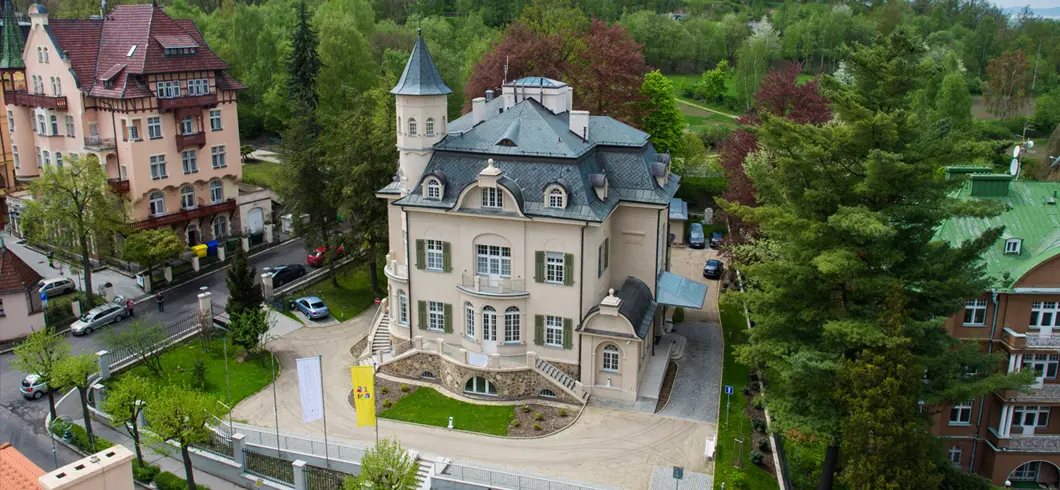
The Becher Villa

None of the Becher family ever moved into this beautiful villa, because its builder, the manufacturer Gustav Becher, died just before moving in. It was then owned by the Association for Chemical and Metallurgical Production, whose only contribution was to build a wine cellar in the basement.

In 1938 it became the seat of the regional SS command, and after the war the communists turned it into the House of Pioneers and Youth (the Pioneers were the communist children’s organisation), where, among other things, a model aircraft club was run – which I can personally vouch for, because I built quite a few little aeroplanes there with my own hands in my time.

In 1987 the building was closed and left to decay until 2009, when it underwent a sensitive and demanding reconstruction costing nine million Czech crowns, of which a full eight million was supplied by the “hated” European Union. Today it houses an interactive gallery for young artists, and the villa itself is a cultural monument of the Czech Republic.

Stop 3

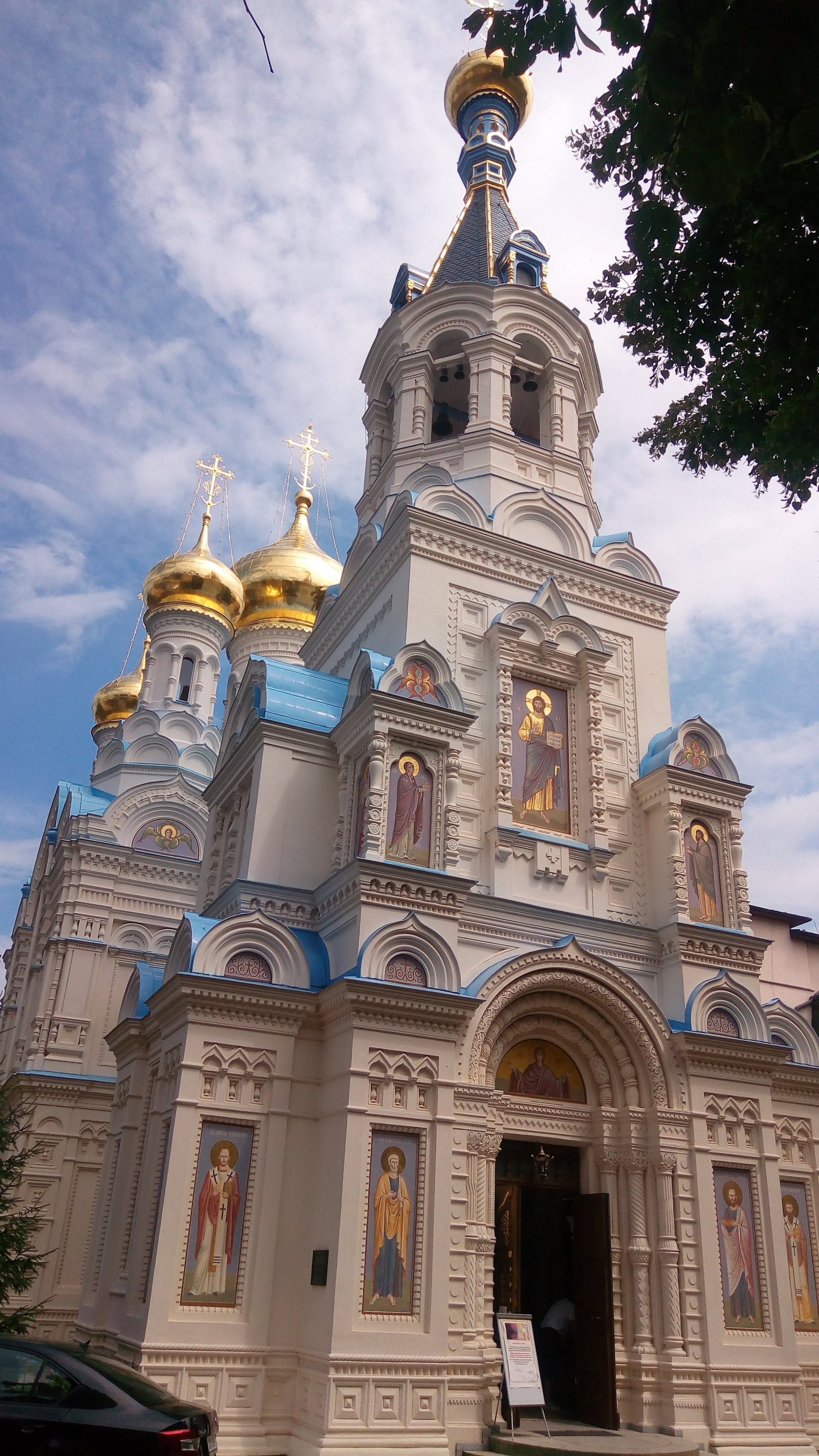
Orthodox Church of Saints Peter and Paul

Orthodox Church of Saints Peter and Paul

The Orthodox Church of Saints Peter and Paul was built between 1893 and 1898. The model for the building was the Byzantine–Old Russian church in Ostankino, near Moscow.

The necessary funds were provided by the wealthy Serbian and Russian clientele of the spa. The church recently underwent a fairly demanding reconstruction, completed in 2015. It cost three million euros in all, of which a third came from Russia and the rest was paid for by wealthy patrons. The domes really are made of gold – altogether sixty thousand sheets of 24-carat gold leaf, each measuring eight by eight centimetres. The lifespan is estimated at roughly thirty years, because you cannot stop the pigeons.

Stop 4

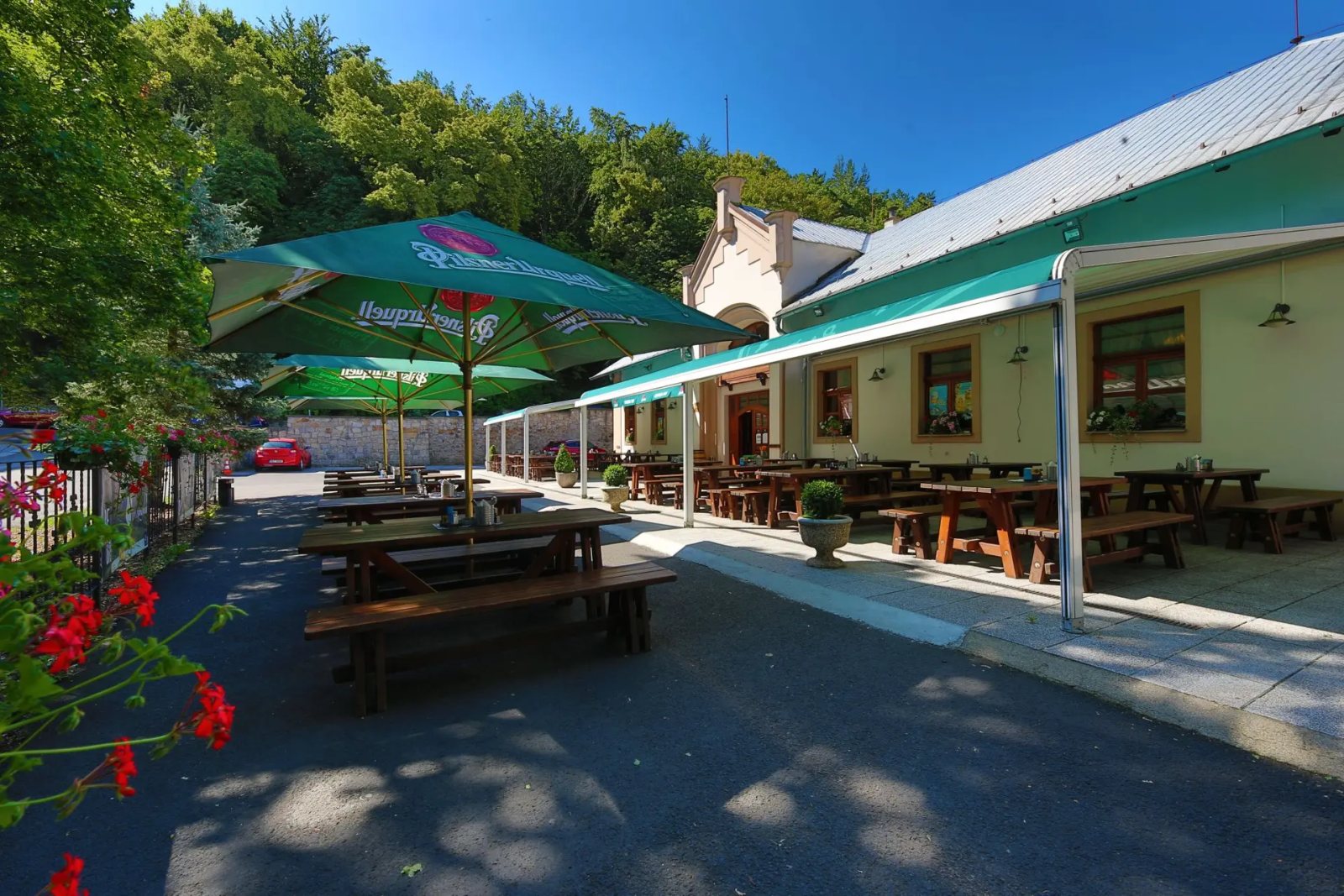
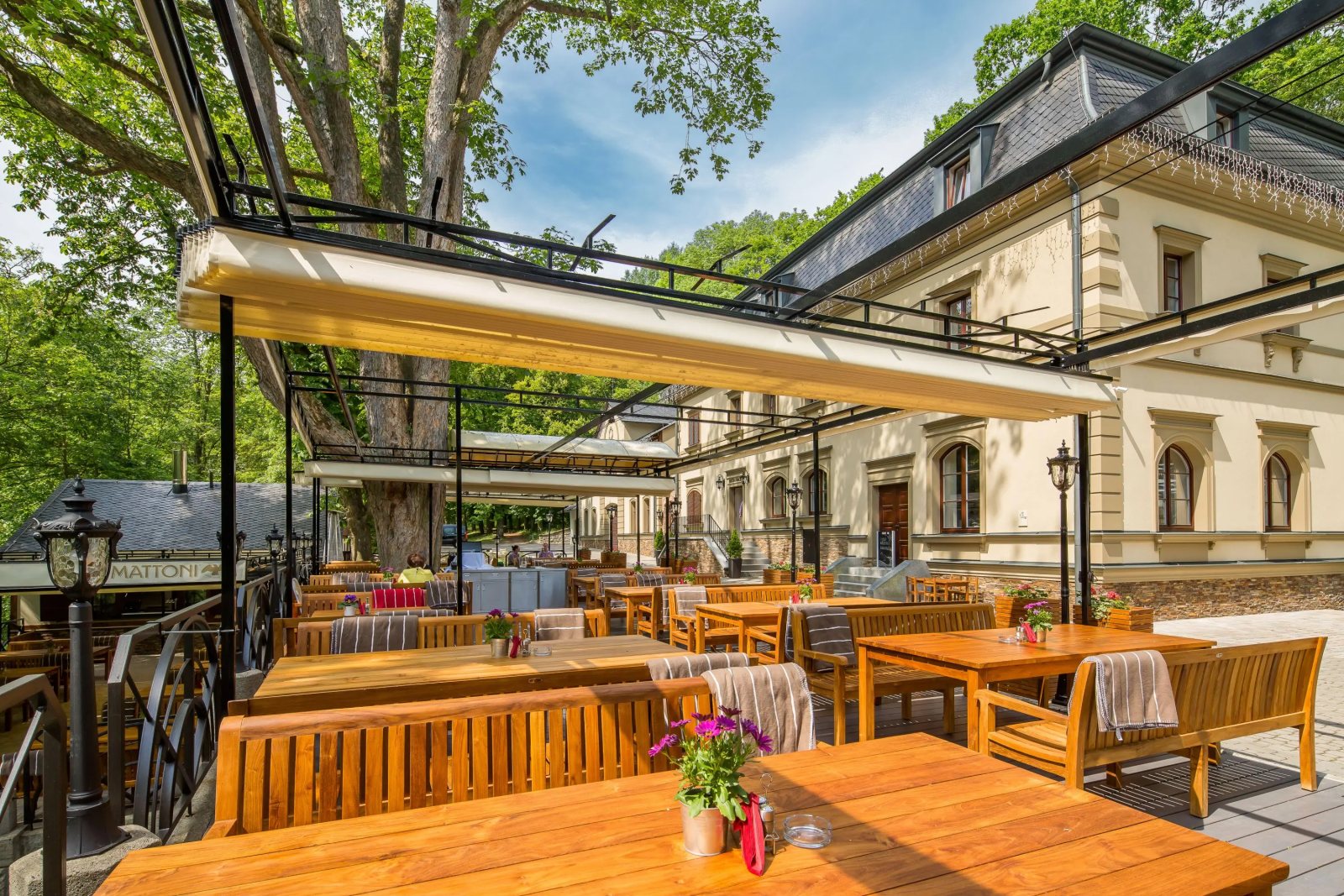
The Little Versailles Restaurant

The garden restaurant, called Malé Versailles in Czech, was originally named Cihelna (“the Brickworks”), because a brickworks really did stand on this spot from 1759. By around 1780, however, part of it had been converted into an inn hall with a handsome garden.

Although bricks were still being made here until the end of the nineteenth century, it was the restaurant, much loved by the people of Carlsbad, that came more and more to the fore.

And not only by them – in 1820 the inn was even visited by the German poet J. W. Goethe. The author of this little guide himself celebrated passing his school-leaving exams here in 1982, at a party where the beer flowed freely and freedom was still nowhere in sight.

Stop 5

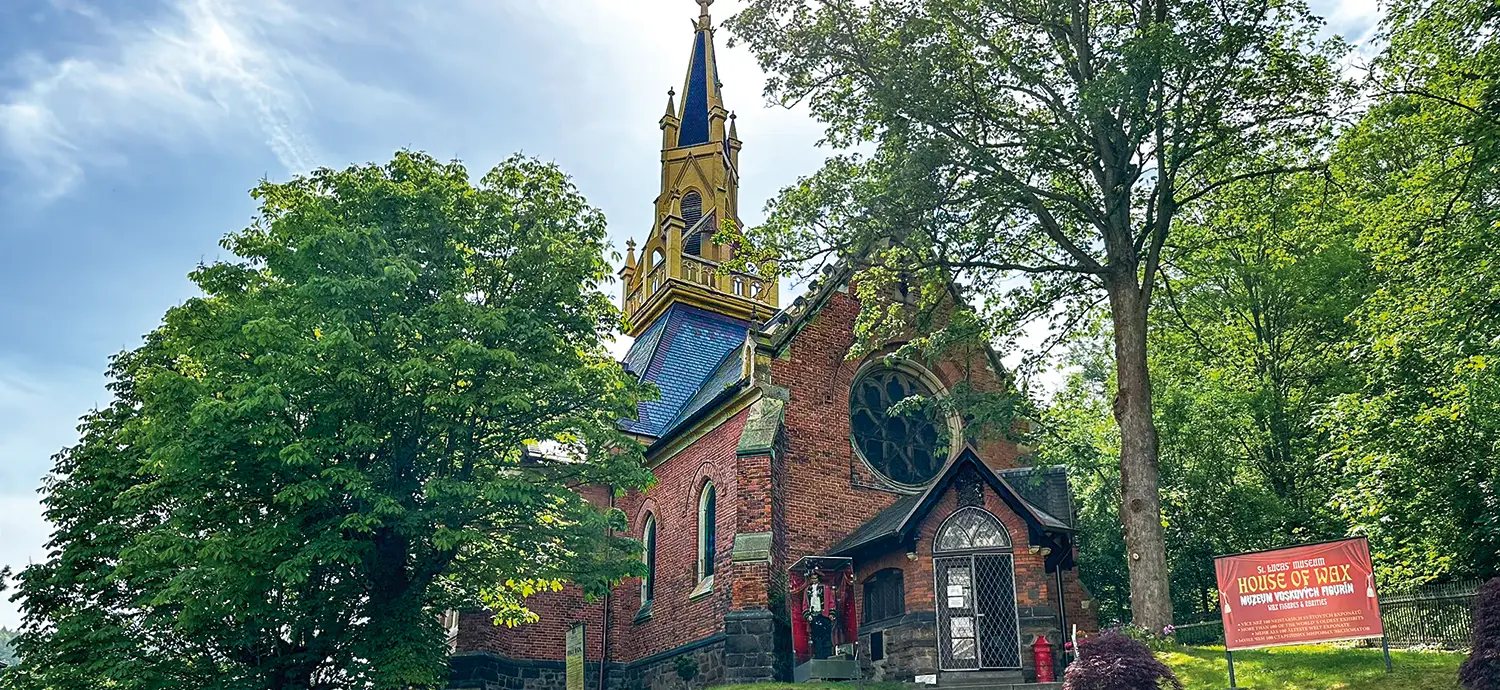
St Luke’s Church

The English, too, spared no expense and clubbed together to build a church in the Gothic Revival style. It was consecrated in 1877 and today it houses a museum of wax figures.

The exhibition consists of the oldest wax figures in the world, which will introduce you to famous visitors to Carlsbad, notable royal families, presidents, politicians, military commanders, dictators, stars of TV series and the music scene, sportsmen and other cult figures from all over the world.

You can also see a unique forty-minute film about what the spa town looked like between 1919 and 1934. The church itself is a national cultural monument.

Stop 6

Castle Hill

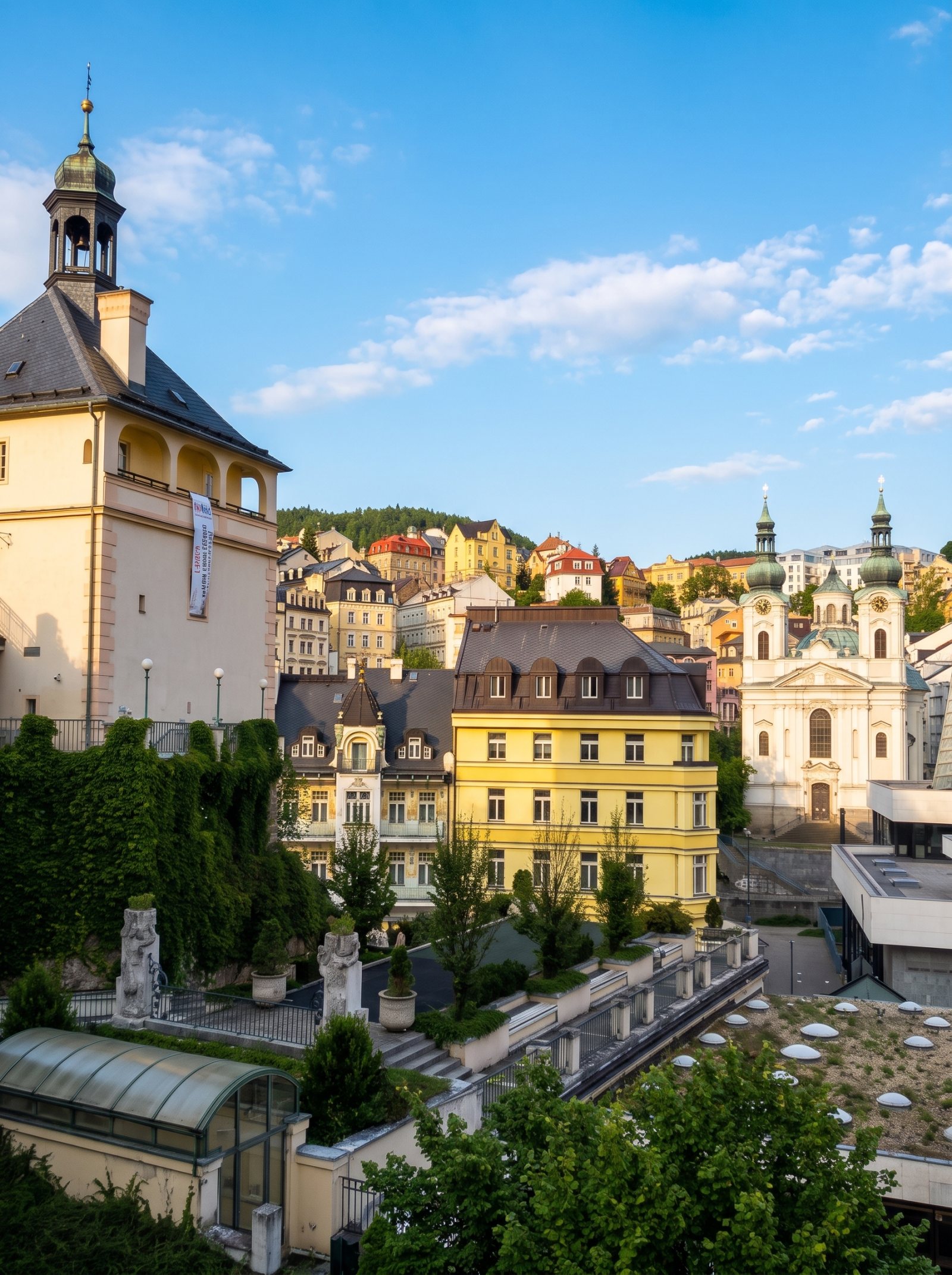
The Castle Tower above the Market Colonnade

They say that wherever Charles IV stayed, a castle sooner or later appeared. It is therefore surprising that Carlsbad has no castle. But that is not quite true. The spa town once had a small castle, and you are standing on the spot where it burned to the ground in 1604. Only its tower survived, which was later converted into the town watchtower.

But in 1759 it burned down too, and at that moment the town councillors had a splendid and economically rewarding idea. They had the whole tower restored and rebuilt, so that from it they could welcome very distinguished guests with fanfares. Not for free, naturally.

An apartment for the tower keeper was built in the attic. The tower keeper’s wife ran around town every day offering this splendid service to arriving visitors. As soon as she had collected the sum, which of course varied according to the importance of the guest, she sent off the equivalent of an e-mail in those days – her children, who raced up to the tower. The tower keeper meanwhile called out the name and any title of the paying guest. Great service. Today nobody blows the trumpet any more, and on the top floor of the tower you will find a cosy and not overly expensive restaurant. At least by local standards.

Stop 7

Diana Lookout Tower

The Diana Lookout Tower
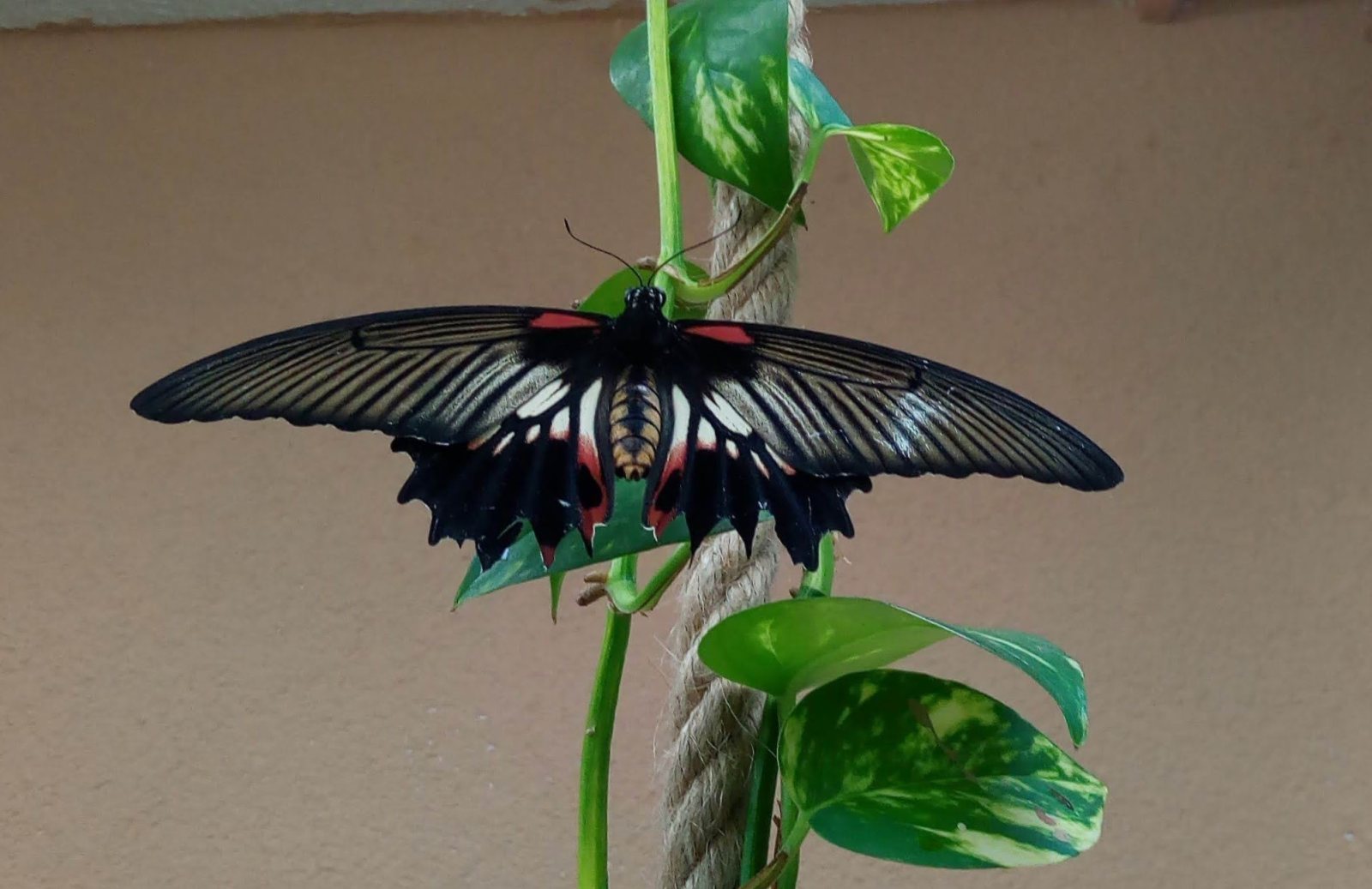
Butterfly

It has stood on the hill since 1914 and offers an enchanting view of the town and its wide surroundings – if you are lucky and it is not hazy. A little way aside stands a restaurant with a ballroom, where social events were once held, such as dance courses for teenagers, including their final balls. A funicular had been running since 1909, so getting to a ball in evening gowns was not much of a problem.

The trouble came only at the end of the event, especially in the winter months, when it was time to go home. The funicular stopped running rather early, so the way down the hill along winding little paths was quite an adrenaline-filled experience.

When the number of twisted ankles, broken legs and bruised tailbones exceeded a bearable level, such events were moved to more accessible parts of town.

Today, besides the restaurant, there is also the Butterfly House (opens on another website in a new window), which I warmly recommend visiting. Here comes the lunch break at the local restaurant, followed by the second part of our short sightseeing walk.
Part Two of the Route

After the lunch break, from the Municipal Theatre to the Elizabeth Baths

Stop 8

The Municipal Theatre

The Municipal Theatre by Fellner and Helmer

The municipal theatre was the work of two architects whom we have already had the honour of meeting: Fellner and Helmer. These gentlemen, after all, designed more than twenty buildings, among others the Garden Colonnade, which we shall come to later.

Construction of the theatre took a mere two years and included plenty of high-quality fire-safety measures, because the catastrophe that had struck the National Theatre in Prague was still fresh in people’s memory.

I can add one lesser-known curiosity. From the box reserved for the most distinguished visitors the view of the stage is very poor, almost nil. Because in those days it was not so important to see, but to be seen.

Stop 9

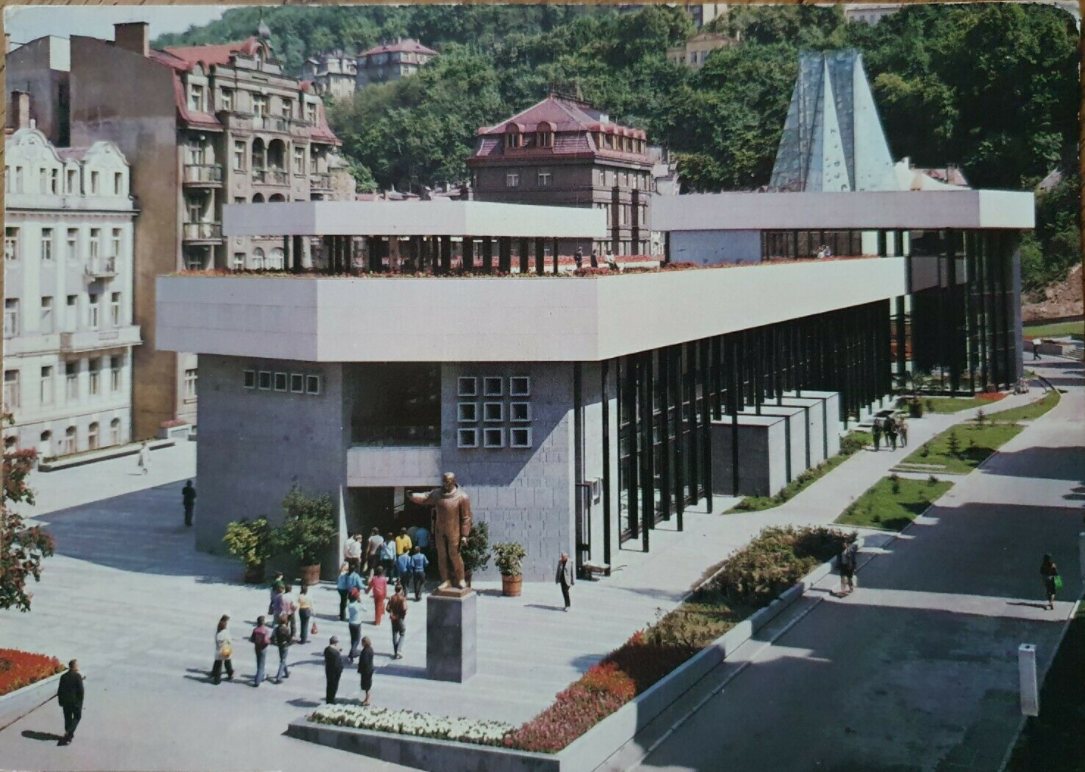
Vřídlo – the Hot Spring

One of the most famous natives of Carlsbad is probably David Becher. He was born in 1725, studied at Charles University in Prague, and then wandered for a while as a physician in Vienna, where he did not much enjoy himself, so he returned to his home town and changed the system of spa treatment beyond recognition, once and for all. He was fascinated by balneology and was nicknamed the Hippocrates of Carlsbad.

Until then, treatment had been more of a torment. Doctors of the day recommended sitting in tubs of healing water from the Vřídlo for so long that the patient’s skin began to crack. They believed that this was how all illnesses left the body. Today we call it “detox”. Then some rascal got the idea that it might not be a bad thing to try drinking the water too – and made guests consume it by the bucket.

Then came Dr David Becher and put an end to the guests’ suffering. He devised and put into practice the treatments and the moderate sipping of the healing springs, which have survived to this day. His motto was “drink and walk”, which, as you will see on the colonnade, patients still do to this day.

The Becher family, who are said to have lived in the town since 1537, brought the town not only instructions on how to drink water but also enriched the whole world with a miraculous herbal liqueur – Becherovka.

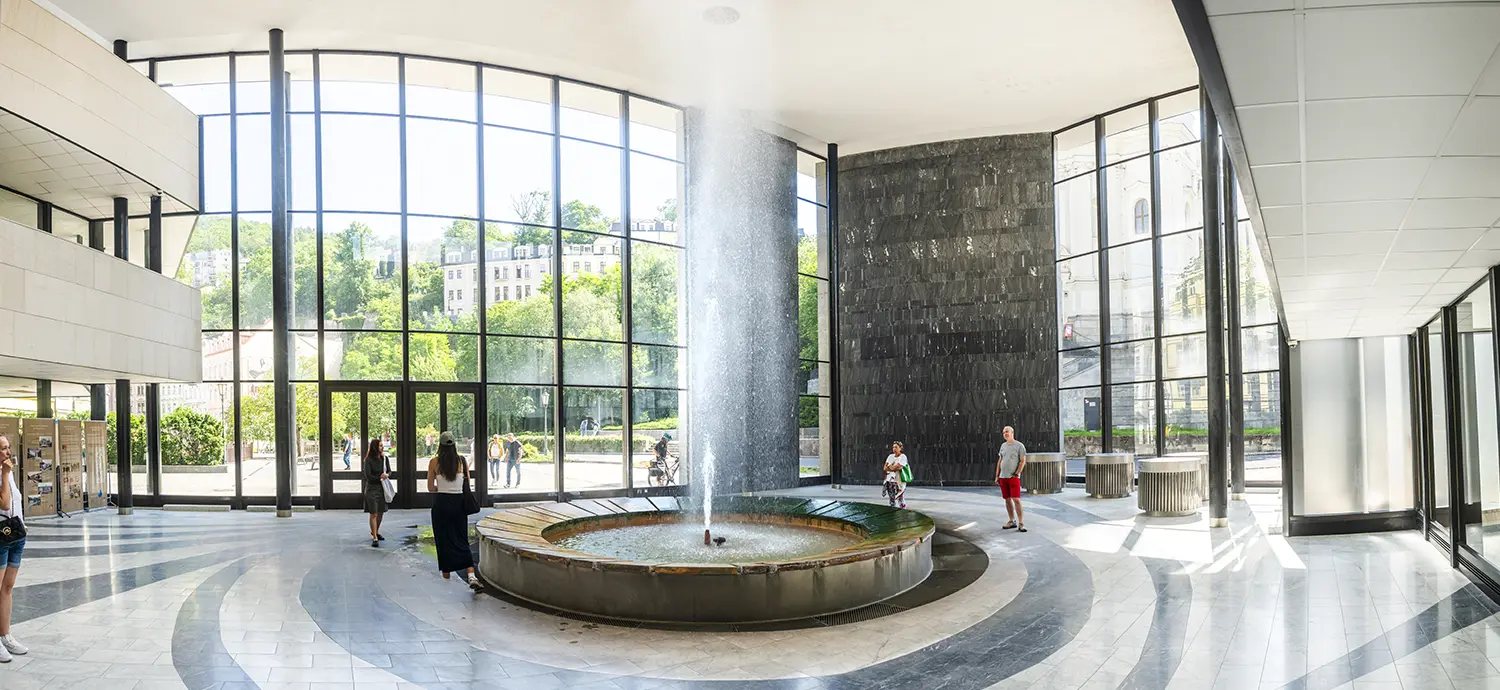
The most famous geyser in Carlsbad can be quite unpredictable. The structure you see today was completed in 1975 and bore the name Gagarin Colonnade. You will not find the statue of the famous cosmonaut here any more – it found a fitting place at Carlsbad airport. The people of Carlsbad never accepted this monstrous building as their own, just like the Hotel Thermal.

There are fifteen springs in all, but only thirteen are open to the public. The Vřídlo itself is back in operation after a long and demanding reconstruction. It should shoot up to a height of 14 metres.

Stop 10

The Market Colonnade

The Market Colonnade with the Castle Tower

Or the Wooden Colonnade. It has stood here since 1883, cost a mere 10,000 florins of the time, and was designed by the Viennese architects Fellner and Helmer.

The very first spa baths of Carlsbad once stood on this spot. Tradition has it that a wide stone seat was carved into the rock here, on which Charles IV himself used to sit, soaking in the healing spring a leg wounded at the Battle of Crécy.

Later the old town hall stood here, but it was pulled down in 1875, whereupon a competition was announced for the construction of another colonnade. The councillors chose and re-chose among the submitted designs for so long and so carefully that in the end nobody was chosen. Construction was finally entrusted to two gentlemen who had, a little earlier, been at the birth of both the Garden Colonnade and the Hot Spring Colonnade.

The brief is said to have been: “Gentlemen, don’t you happen to have some little idea for a temporary structure?” The gentlemen did. In the 1990s the so-called temporary structure was sensitively restored, and it has lasted to this day. You will find three springs here, but I do not think you will enjoy the taste of any of them.

Stop 11

The Mill Colonnade

The Mill Colonnade

The Mill Colonnade was built by the architect Josef Zítek between 1870 and 1881. Plenty of the town’s inhabitants complained at the time that it did not suit the ancient spa town because it was too modern. Well, builders have never had it easy.

Today it is the main promenade for spa guests, but few people know that another colonnade had stood here before it. A wooden one. It was simply called “Dupárna” (roughly, “the Stomping House”). The floor of the whole structure was made of wood, and every step could be heard far and wide.

The townspeople living close by kept complaining… And so the town councillors finally announced an architectural competition, which was won by the aforementioned Zítek. The main condition of the competition was the complete absence of wood. A stone colonnade was therefore designed, but even Zítek did not manage to push through his original design, in which the colonnade had two storeys. The councillors simply cancelled one storey, and after a long ten years it was finished. The people of Carlsbad, however, never took the building to their hearts, so right from the start it received several derogatory nicknames: the Bowling Alley or the Carrot Patch.

Time, however, soothed the heated minds, and the Mill Colonnade must not be missing from the photo collection of any tourist. It has also appeared in several films – Vlasta Burian, the great comedy star, romped about here while shooting the film Tři vejce do skla (“Three Eggs in a Glass”). And many years later so did the fleeing head waiter played by Josef Abrhám, which I know for certain, because I appeared in that film for a moment as an extra.

Stop 12

The Petr House

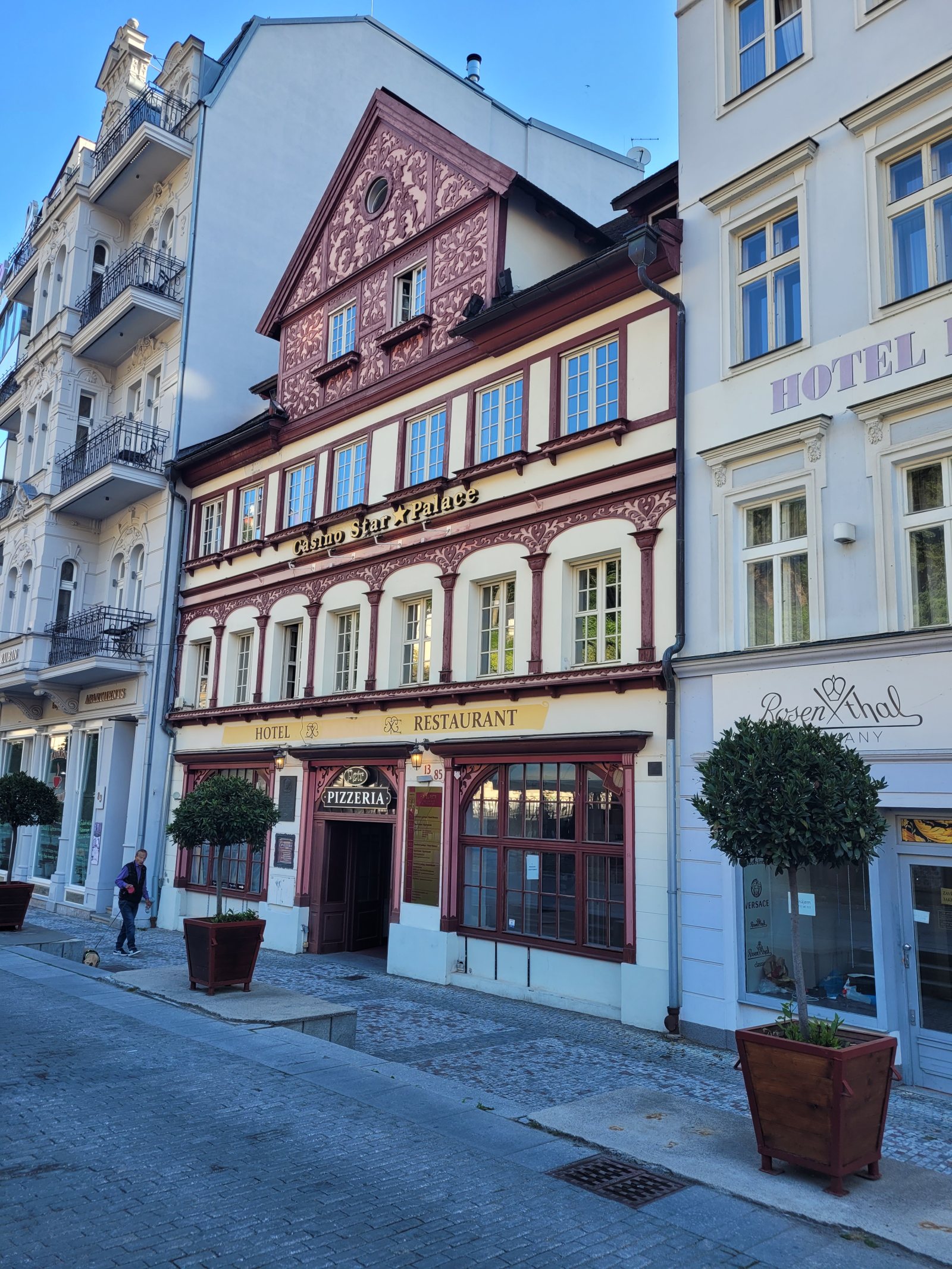
The half-timbered Petr House among burghers’ houses

The Petr House is one of the oldest Baroque half-timbered houses in Carlsbad. When it was built, it stood just outside the town gate from which the road led to Cheb. At the beginning of the eighteenth century the town of Carlsbad ended exactly here.

The house was originally called At the Golden Ox (U zlatého vola), but today you will find on it a memorial plaque commemorating a visit by the Russian tsar Peter the Great. The house was not, however, named in his honour. The plaque commemorates an event that took place right opposite. There once stood the house At the Peacock (U páva), which the tsar himself helped the masons to build in 1711, with his own hands. The house bears the name of one of its tenants – Johann Petter.

After the Second World War a cinema café was set up in it, a sort of forerunner of today’s multiplexes. With one difference – you were allowed to smoke and drink alcoholic beverages there. In 2000 the house was completely reconstructed, but the cinema café was never reopened.

Stop 13

The Garden Colonnade

The cast-iron Garden Colonnade

Here the Viennese architects Fellner and Helmer, already mentioned several times, had another field day. Only a fragment of the whole structure has survived, which was called the Blansko Pavilion after the ironworks where the cast-iron parts from which the colonnade is assembled were made. The pavilion contained a concert hall and also a restaurant. It served as a social centre where people played music and danced to the accompaniment of the famous Carlsbad Spa Orchestra.

The popular hits of the day were above all the pieces Carlsbad Waltz and Spa Polka.

The Carlsbad Spa Orchestra was founded by the conductor Labitzky as long ago as 1835, so it is among the oldest orchestras anywhere. And it holds one distinction – on 20 July 1894 the European premiere of Dvořák’s New World Symphony took place at the local Post Court. And with the composer’s own permission, too.

In 1966 the pavilion was pulled down and only what you see now remained. You can drink from the Snake Spring (Hadí pramen), but it is not Becherovka.

Stop 14

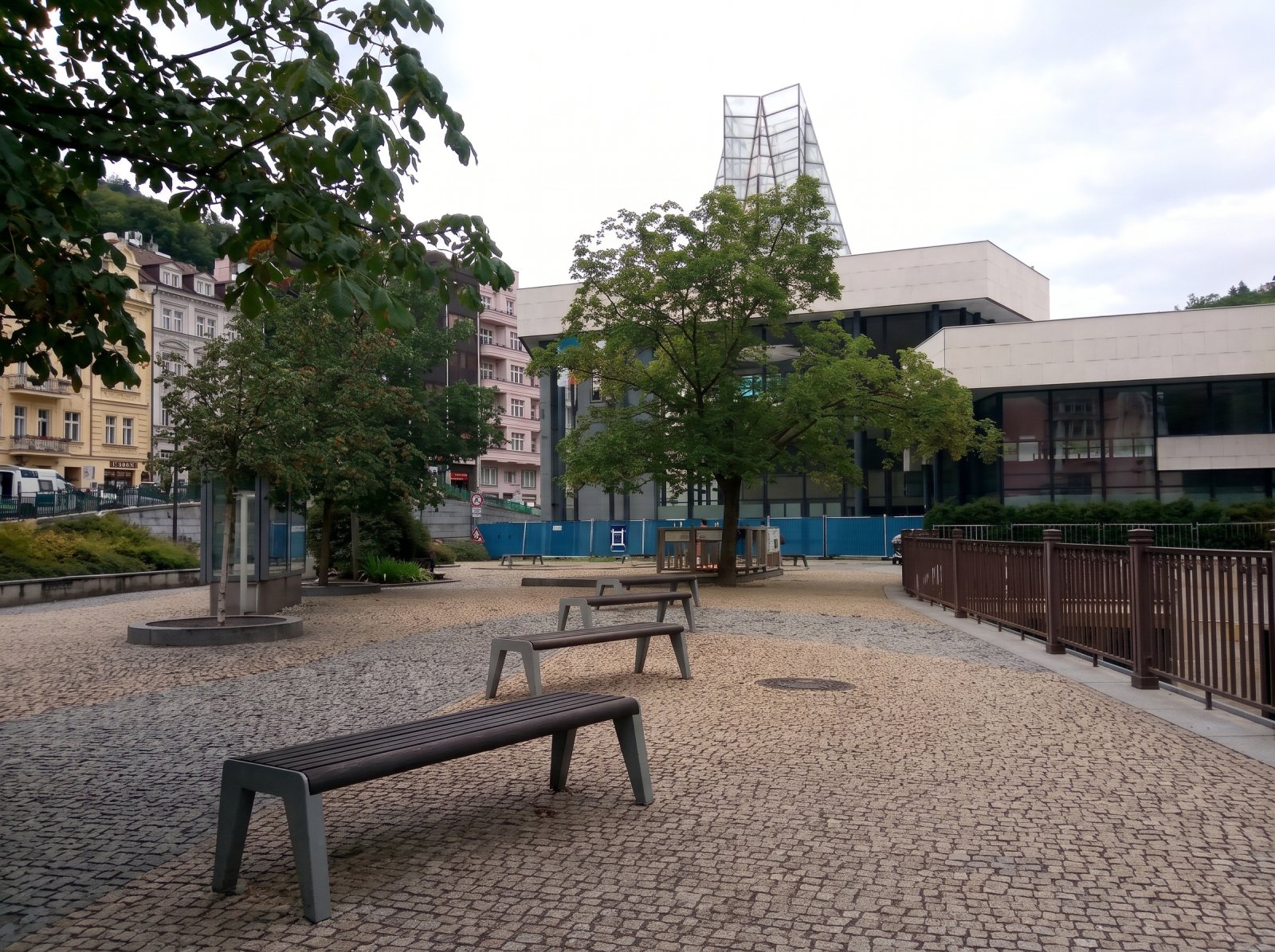
Hotel Thermal

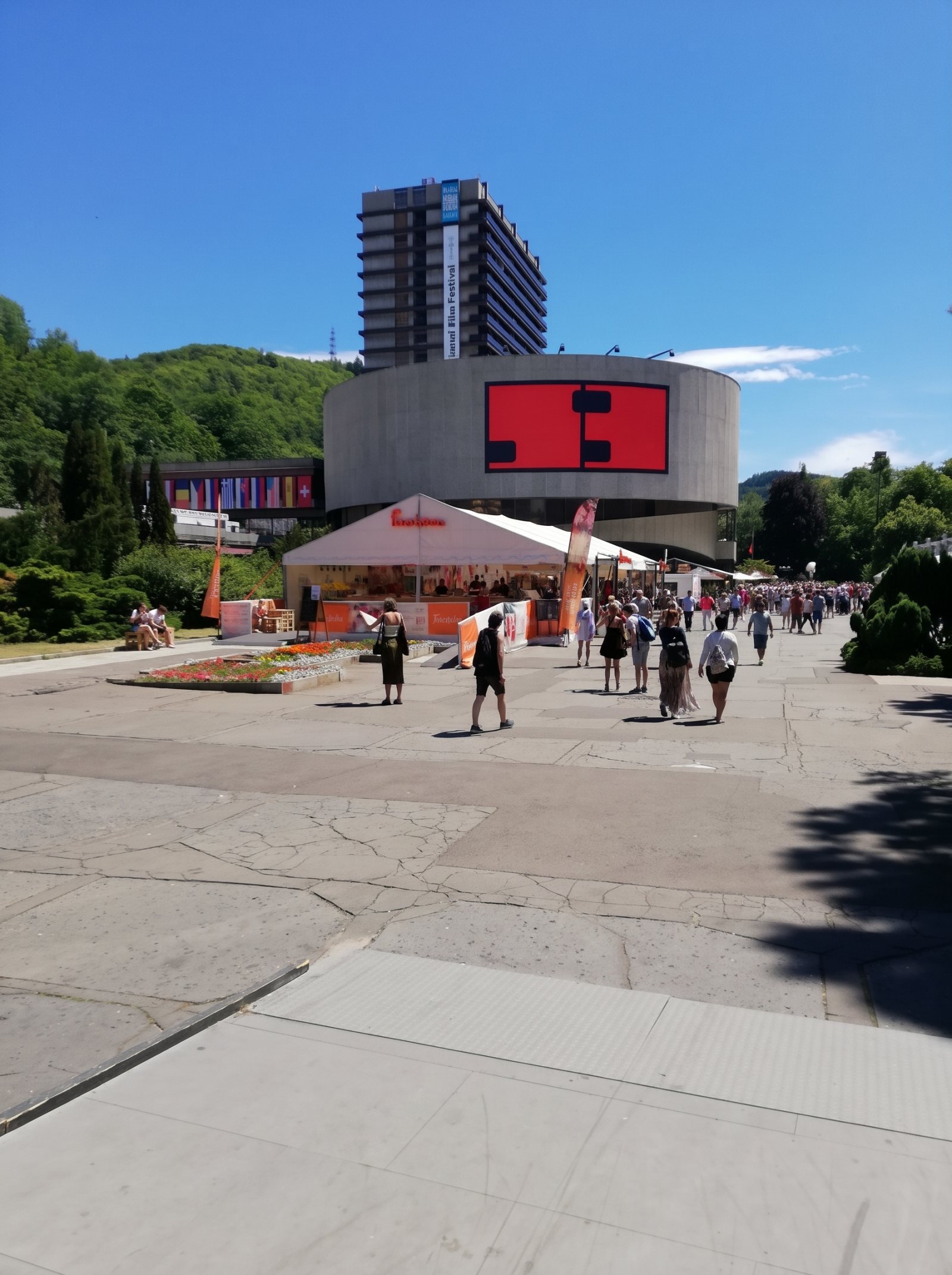
The Hotel Thermal and the festival palace

The construction of this concrete monster, whose appearance and insensitive placement in the spa zone the natives of Carlsbad never came to terms with, took ten years, and more than thirty historic houses were sacrificed to it. From 1967 to 1977, when the hotel was ceremonially opened. An international film festival is held in it every year, which was also the reason for building this modern structure.

As things went in those days – the order came from Moscow. The first festival was held here as early as 1946, then still as a non-competitive one. In 1956, after Stalin’s death, even the film-makers from the West for the first time took the festival back into their favour.

So a clear instruction came from Moscow: you must provide perfect technical conditions for the festival, whatever it takes, and show the West that Czechoslovakia can organise a festival as well as France or Italy can. The Communist Party (KSČ) therefore set the fundamental task: to build a magnificent festival palace… From this political assignment to its realisation, under the conditions of the controlled Czechoslovak planned economy, almost 20 years passed.

We have had it here ever since, and I swear – we still cannot get used to it. 😊

Stop 15

The Elizabeth Baths

The Elizabeth Baths

The baths were founded in 1906 and named after Empress Elisabeth, known as Sissi, who also visited Carlsbad. Under socialism they were known simply as Spa V (Lázně V).

The Elizabeth Baths are currently the last truly public baths in town. So if you intend to pay for treatments or visit the pool complex, nobody will stop you. You will just have to dig a little deeper into your wallet.

But that is how it has always been in Carlsbad, except for the socialist era, when people came to town for as long as three weeks on the so-called “křížek” – a spa stay paid for by the state (the word literally means “little cross”).

But that is another story, one that mainly concerns me, because it was here that I met my wife, and that little tale would not interest you one bit.

If it does, though, we can set out next year on another interesting route and visit, for example, the nearby castle that Charles IV liked to visit. Beneath its walls there is a splendid little local brewery and a small museum of this divine drink.

Compiled by

Miloslav Lešetický (opens on another website in a new window), a native of Carlsbad (Karlovy Vary), now living in exile on the eastern edge of the Czech Republic – in what the locals jokingly call “Prajzsko” (“Prussia”).

Over his working life he built about two hundred websites and helped to finish the book CSS – hotová řešení (opens on another website in a new window) (“CSS – Ready-made Solutions”, in Czech). He is now in web-design retirement, but is still capable of producing a nice website.
He writes his own blog, Blábolník (in Czech; roughly “The Nonsense Notebook”), has published one humorous book (opens on another website in a new window) (also in Czech) and collects snippets of life with a chihuahua.
The author thanks you for your attention.

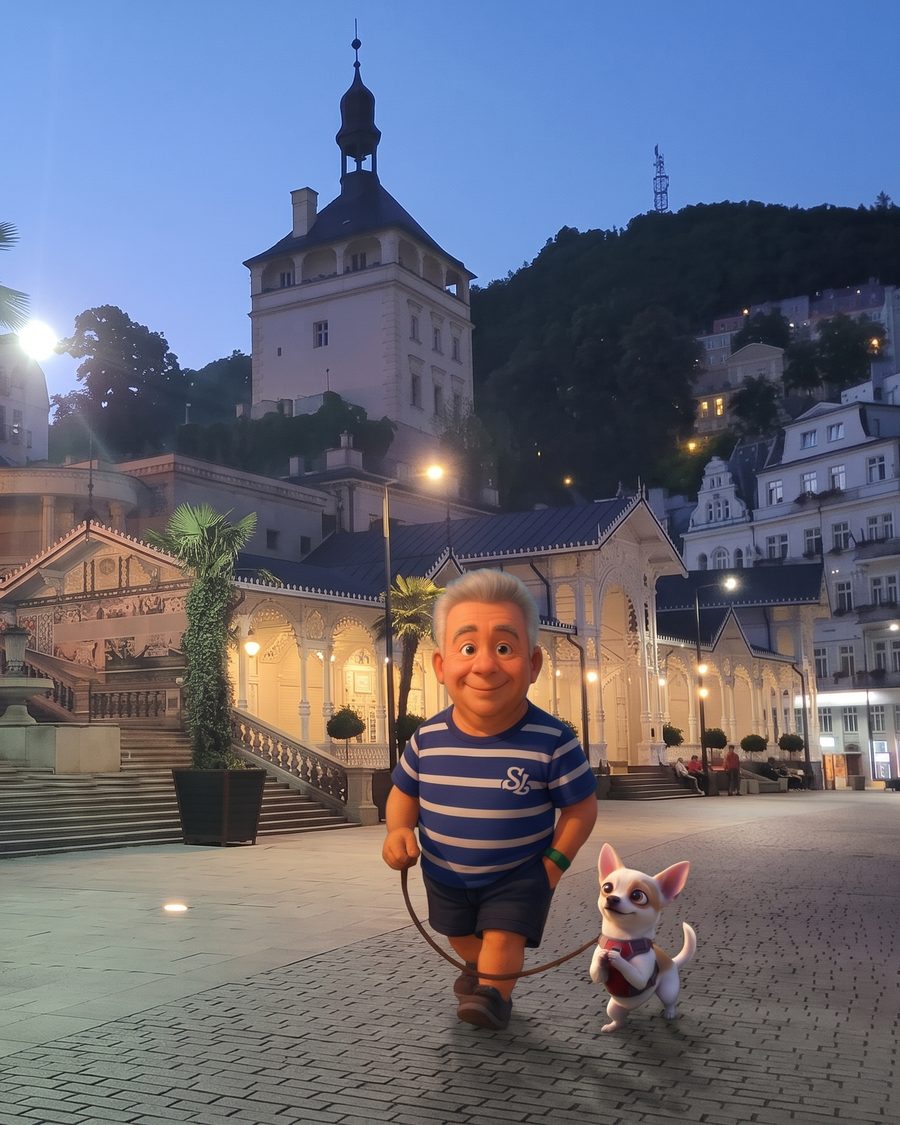
A cartoon figure of a grey-haired man in a striped shirt, walking a small white chihuahua on a lead across the square in front of the Market Colonnade and the Castle Tower
Plaváček out for a walk